
EM@3AM – Acute Angle Closure Glaucoma
Welcome to EM@3AM: This week let’s refresh our memories regarding a can’t miss diagnosis in a patient with a painful, red eye.
EM@3AM – Acute Angle Closure Glaucoma Read More »


Welcome to EM@3AM: This week let’s refresh our memories regarding a can’t miss diagnosis in a patient with a painful, red eye.
EM@3AM – Acute Angle Closure Glaucoma Read More »
Welcome to EM@3AM: Let’s review a cause of significant morbidity and mortality in sickle cell patients.
EM@3AM – Acute Chest Syndrome Read More »
The patient with headache, myalgia, and URI symptoms may just have the common flu. But what could you be missing? This post details ED evaluation and management of patients with influenza, as well as important mimics.
Influenza and Considerations Regarding Infectious Mimics Read More »
Welcome to EM@3AM, an emDOCs series designed to foster your working knowledge by providing an expedited review of clinical basics. We’ll keep it short, while you keep that EM brain sharp.
EM@3AM – Acute APAP Toxicity Read More »
Welcome to EM@3AM, an emdocs series designed to foster your working knowledge by providing an expedited review of clinical basics. We’ll keep it short, while you keep that EM brain sharp.
EM@3AM – Abdominal Aortic Aneurysm Read More »

Interstitial lung disease refers to parenchymal and interstitial inflammation and fibrosis, and acute exacerbation can cause significant morbidity and mortality. Many conditions are associated with this, including those with an underlying systemic disorder, those with a known trigger, and those that are idiopathic in nature. This post provides key points on evaluation and management of ILD in the emergency department.
Interstitial Lung Diseases: Evaluating for an Acute Exacerbation Read More »
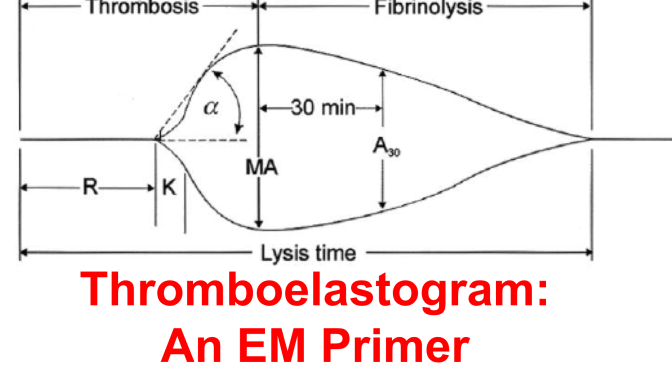
Thromboelastography is a mechanism of assessing coagulation based upon the viscoelastic properties of whole blood, and when compared to other coagulation assessments, this test allows for an assessment of near real-time, in-vivo clotting capacity. The point-of-care assay, which uses graphic interpretation of thromboelastography (the TEG), offers the opportunity for an expedited assessment of coagulopathies (thrombocytopenia, factor deficiency, heparin effect, hypofibrinogenemia, and hyperfibrinolysis). How can you use this modality in the ED? This post is full of pearls on interpreting TEG.
The Thromboelastogram (TEG®): A Five-Minute Primer for the Emergency Physician Read More »

Managing Sexual Assault in the Emergency Department
This review will address patient stabilization, provide recommendations for obtaining a medical and assault history, and detail pregnancy and sexually transmitted infection prophylaxis. An in-depth discussion of the forensic examination will be omitted, as requirements regarding healthcare provider training, tools contained within forensic collection kits, time allotted between alleged assault and court admissible evidence collection, and chain of custody legislation vary according to individual state law.
Managing Sexual Assault in the Emergency Department Read More »

Need a quick refresher on how to address a suicidal patient? This article offers key tips and tricks for your emergency department evaluation and management.
Emergency Department Tips & Tricks for Managing the Suicidal Patient Read More »

Hypoglycemia is a common presenting complaint in the emergency department. This post will reveal several tips and tricks for the evaluation and treatment of hypoglycemic patients.
The Adult Hypoglycemic Patient: Tips for Emergency Department Management Read More »