I recently had the pleasure of engaging in a point-counterpoint discussion on the optimal agent for Rapid Sequence Intubation with Billy Mallon at Essentials of Emergency Medicine 2014. I took the pro-rocuronium side.
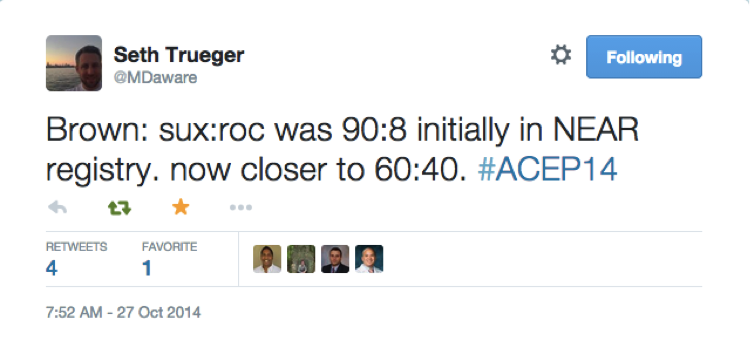
For decades, succinylcholine (suxamethonium) was the paralytic agent of choice (and the only available option) for RSI. The National Emergency Airway Registry (NEAR) found that it was used in 90% of airways. Succinylcholine has a number of perceived advantages that led to this situation:
- Rapid onset (45-60 seconds)
- Short half-life (6-8 minutes of paralysis)
Rapidly achieving an optimal intubating environment is critical as prolonged time to paralysis can delay successful intubation, potentially leading to oxygen desaturation. Early data demonstrated that succinylcholine reached optimal intubating parameters more rapidly than rocuronium (Sluga 2005, McCourt 1998, Laurin 2000). However, this difference was shown to be caused by inappropriate dosing of rocuronium (0.6 mg/kg in most studies). When a 1.2 mg/kg dose of rocuronium is given, the time to achieving optimal intubating parameters is virtually equivalent (Herbstritt 2012).
Rapid offset has been touted as an advantage because if the airway provider was unable to intubate the patient, the drug would wear off quickly and the patient would resume spontaneous breathing before desaturation occurs. We will see later why this logic is flawed.
Over the last 4-5 years, the RSI agent preference has swung away from succinylcholine.

There are likely numerous reasons for this swing including drug shortages but a better understanding of the limitations of succinylcholine are also likely at play. […]