Authors: Stephanie Teeling, MD (EM Resident Physician, CMC – Charlotte, NC) // Reviewed by: Bryant Allen, MD (EM Physician, CMC); Sophia Görgens, MD (EM Physician, Yale University, CT); Cassandra Mackey, MD (Assistant Professor of Emergency Medicine, UMass Chan Medical School); Brit Long, MD (@long_brit); Alex Koyfman, MD (@EMHighAK)
Welcome to EM@3AM, an emDOCs series designed to foster your working knowledge by providing an expedited review of clinical basics. We’ll keep it short, while you keep that EM brain sharp.
A 72-year-old female with a past medical history of hypertension, hypothyroidism, and Alzheimer’s dementia is transferred from her SNF with hallucinations and agitation. She was noted to be throwing objects at staff and was not redirectable. On ED arrival, she is looking around and appears to be responding to internal stimuli. She is not following commands, picking off the EKG leads, pushing the healthcare technician away from her, and anytime someone tries to start an IV or put a blood pressure cuff on her, she swings at them and has already punched EMS and one of the nurses. She is unable to be verbally redirected for IV establishment but allows you to get an EKG and opening set of vitals. VS include HR 98 bpm, BP 124/78, RR 18, T 98.4 F, point of care glucose level 118.
What is your next step in evaluation and management?
Answer: Management of agitation in the elderly
Epidemiology
- Agitation occurs in up to 10% of the elderly population in the ED and is frequently associated with delirium.1It can often go unrecognized.
- Elderly individuals are at increased risk due to multiple factors such as polypharmacy, underlying dementia or baseline cognitive decline, sensory impairment, and medical comorbidities.
- Agitation alone should be a diagnosis of exclusion and secondary causes such as an underlying medical condition should be ruled out.
Etiologies
- It is imperative to determine the etiology of agitation in all cases, especially in the elderly prior to immediate pharmacologic intervention.
- Identification and treatment of reversible causes should be prioritized.
- The differential diagnosis largely mimics the broad differential of altered mental status. Agitation is a symptom, not a diagnosis.
Common causes2
- Delirium triggered by infectious process (UTI, pneumonia, sepsis) or other medical problems(urinary retention, metabolic disturbance)
- Polypharmacy, drug-drug interaction, medication overdose or withdrawal
- Neurologic (stroke, ICH, seizure)
- Exacerbation of underlying psychiatric condition
- Dementia-related behavioral disturbance
- Delirium affected by environmental factors (sleep deprivation, unfamiliar surroundings)
Clinical presentation
- Agitation exists on a spectrum from mild restlessness to violent aggression. Features suggestive of delirium include acute onset fluctuating mental status, inattention, altered level of consciousness, and disorganized thinking with waxing and waning symptoms.2
- Hyperactive delirium can present with patients pulling at lines or tubes, experiencing hallucinations, exhibiting combative behavior, or emotional lability.
- Worsening prognostic signs in delirium include hypoactive subtype (lethargy, drowsiness, slowed movement), older age, frailty, duration of delirium, and severity).3
- Features suggestive of medical etiology: fever, hypoxia or other grossly abnormal vital signs, trauma, sudden change from baseline, new focal neurologic deficit, or signs/symptoms of a toxidrome.
Evaluation
Initial priorities
- ABC’s
- Assess immediate safety risk to patient and staff (i.e., remove sharp objects)
- Prioritize verbal de-escalation when possible
- Identify reversible causes prior to pharmacologic sedation
Work-up – guided by history and physical exam1
- POC glucose
- CBC, BMP or CMP
- UA, urine culture
- EKG (evaluate QTc prior to antipsychotic medications, evaluate for ischemia)
- CXR if infectious symptoms
- Consider CT head if hx of trauma, focal deficits, hx of anticoagulation use, or new AMS without clear etiology.
- Other considerations: TSH, troponin, toxicology studies, VBG (hypercapnia)
Management
Non-pharmacologic management4 – first line
- Verbal de-escalation
- Place patient in a quiet, low-stimulation environment
- Frequent reorientation, family presence
- Regulate sleep/wake cycle
- Obtain access to dentures, hearing aids, glasses, etc.
- Avoid unnecessary equipment – restraints, foley, monitoring equipment.
- Address needs – hunger, hydration, urinary retention, constipation, sleep deprivation.
Pharmacologic management
- Use the lowest effective dose – elderly patients are more sensitive to sedatives due to altered pharmacokinetics and pharmacodynamics.5
- Oral medications are preferred when feasible.
- Considerations: routes (PO, IM, IV), time of onset, duration of action
- Exact time of onset will depend on the medication but in general, IV onset is typically within 1-10 minutes, IM generally 5-30 minutes, and PO 15-60 minutes+.
- Duration of action also ranges depending on agent.
- When to consider redosing or addition of a different agent:
- Also agent-dependent, generally within 15-60 min.
- Inadequate sedation at expected time of onset.
- Partial response but persistent agitation.
Medication Options
- Antipsychotics (second generation antipsychotic preferred)
- Haloperidol 0.5-1 mg PO/IM/IV or droperidol
- May use higher range of haloperidol (2-5 mg IM) if no contraindications and the patient is at risk to themselves or others.
- Otherwise, avoid large doses.
- Monitor for extrapyramidal symptoms (EPS) (acute dystonia, akathisia, parkinsonism, tardive dyskinesia) and QTc prolongation.
- Olanzapine
- 2.5-5 mg PO/IM
- Lower risk of EPS
- Quetiapine
- Useful in mild agitation or delirium.
- 25-50 mg qhs PO
- Lower risk of EPS
- Haloperidol 0.5-1 mg PO/IM/IV or droperidol
- Benzodiazepines
- Generally avoidedin delirium as they may worsen confusion.
- Appropriate for alcohol withdrawal, benzodiazepine withdrawal, some toxicologic etiologies.
- Antihistamines: diphenhydramine is generally avoided.
- Elderly have decreased drug clearance and age-related cholinergic effects (urinary retention, dry mouth, confusion, agitation, tachycardia, constipation).
- Alpha antagonism effects: hypotension and increased fall risk.
- Associated with increased hospital length of stay.
Complications
- Treatment of delirium/agitation is essential but is not without risks.
- Physical restraints if needed can worsen delirium and increase injury risk. Avoid if at all possible.
- Pharmacologic sedation can cause respiratory depression, falls, increase aspiration risk, cause QT prolongation, hypotension, and EPS. Delirium is associated with increased length of hospital stay, increased mortality, and functional decline.3
Disposition
- Disposition depends on safety and the underlying etiology.
- Admit patients with suspected delirium, medical triggers, or inability to achieve safety at home/facility.
- If patients return to baseline, have a clear non-medical cause, and have reliable support, they may be discharged with close follow-up.
Pearls
- Acute agitation in adults should be considered delirium until proven otherwise.
- Identify reversible medical causes prior to chemical sedation.
- Non-pharmacologic interventions should be first-line.
- Utilize lower doses than in younger adults.
- Avoid benzodiazepines except in withdrawal/toxidromic states.
- Check QTc prior to antipsychotic administration when able.

A 93-year-old woman is boarding in the ED after being admitted to the hospital for a urinary tract infection. She is receiving IV ceftriaxone. The nurse notifies you that the patient is becoming increasingly agitated. She is not cooperative with a repeat examination and attempts to pull out her peripheral IV and climb out of the stretcher. What is the most appropriate pharmacologic agent for this patient’s condition?
A) Haloperidol 5 mg IV
B) Ketamine 1 mg/kg IV
C) Lorazepam 2 mg PO
D) Midazolam 2 mg IM
E) Olanzapine 2.5 mg IM
Answer: E
This patient’s change in mental status is due to delirium, which is characterized by a fluctuating course with impaired cognition, attention, orperception. Features of hyperexcitation or hypoactivity may be observed. The fluctuating course of delirium distinguishes it from other entities such as depression or dementia. Delirium most commonly occurs in the older patient population and is usually triggered by toxins, medications, metabolic derangement, infection, trauma, intracranial disease, or surgery. The primary management of delirium should be focused on addressing the underlying cause. Symptomatic care includes frequent reorientation, preserving sleep-wake cycles, limiting noise, and minimizing the use of medical equipment (catheters, wires, etc.). If nonpharmacologic measures are unsuccessful, pharmacologic therapy may be used.
The use of antipsychotics or sedatives in older patients should be done with caution, and age-adjusted doses should be used. Second-generation antipsychotics such as olanzapine are appropriate first-line therapies. Olanzapine is available in oral, intramuscular, and intravenous forms. Typical adult dosing for hyperactive delirium is 5–10 mg IM or IV, but for older patients, dosing should be started at 2.5–5 mg. Physical restraints should be avoided unless all other options are exhausted and the patient continues to pose a threat to themselves or others.
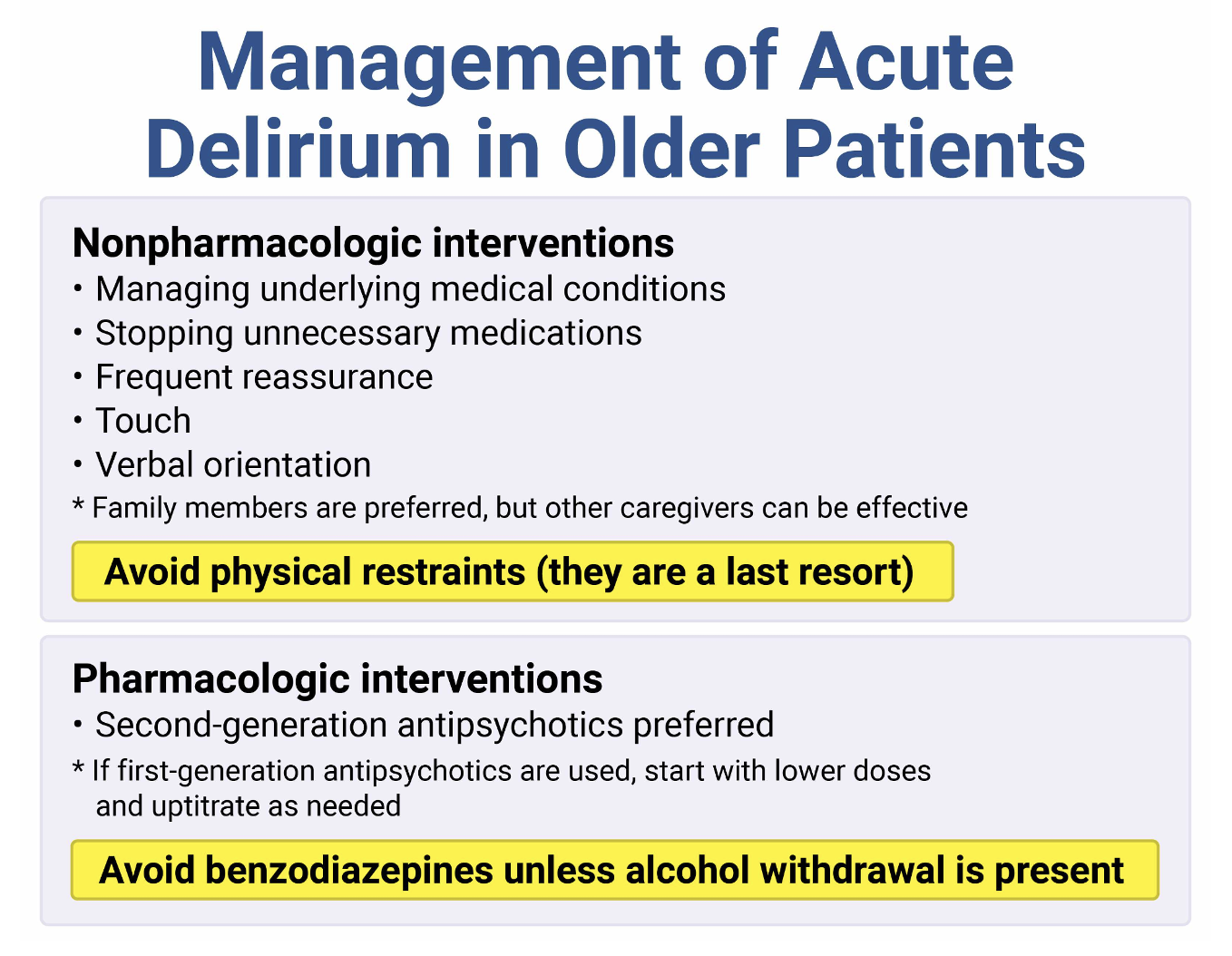
Haloperidol (A) is a first-generation antipsychotic commonly used for the treatment of acute agitation in the ED. However, first-generation antipsychotics are associated with more side effects when compared to second-generation medications. If used for an older patient with hyperactive delirium, the starting dose should be 0.5–1 mg IM.
There is extremely limited evidence for the use of ketamine (B) in treating hyperactive delirium in older patients. Thus, it is not a preferred treatment.
Benzodiazepines such as lorazepam (C) and midazolam (D) may worsen delirium and should be avoided in the older population.
Resources
- Shenvi C, Kennedy M, Austin CA, Wilson MP, Gerardi M, Schneider S. Managing Delirium and Agitation in the Older Emergency Department Patient: The ADEPT Tool. Ann Emerg Med. 2020;75(2):136-145. doi:10.1016/j.annemergmed.2019.07.023
- Han JH, Wilber ST. Altered mental status in older patients in the emergency department. Clin Geriatr Med. 2013;29(1):101-136. doi:10.1016/j.cger.2012.09.005
- Wilson JE, Mart MF, Cunningham C, et al. Delirium. Nat Rev Dis Primers. 2020;6(1):90. Published 2020 Nov 12. doi:10.1038/s41572-020-00223-4
- Hshieh TT, Inouye SK, Oh ES. Delirium in the Elderly. Psychiatr Clin North Am. 2018;41(1):1-17. doi:10.1016/j.psc.2017.10.001
- Wilson MP, Pepper D, Currier GW, Holloman GH Jr, Feifel D. The psychopharmacology of agitation: consensus statement of the american association for emergency psychiatry project Beta psychopharmacology workgroup. West J Emerg Med. 2012;13(1):26-34. doi:10.5811/westjem.2011.9.6866