Author: Brit Long, MD (@long_brit) // Reviewed by Alex Koyfman, MD (@EMHighAK)
Introduction
Necrotizing soft tissue infections (NSTI) are rapidly progressing infections of the skin and subcutaneous tissue (necrotizing cellulitis), the fascial plane (necrotizing fasciitis), or even the muscles (necrotizing myositis). Fournier gangrene involves the perineal region. NSTIs are associated with severe systemic toxicity and multiorgan failure, in part associated with bacterial exotoxin production. While the incidence ranges between 0.2-15.5 per 100,000 person-years, the mortality can be severe.
Methods
The Global Alliance for Infections in Surgery published a position statement comprised of recommendations in the Journal of Trauma and Acute Care Surgery. Authors utilized a comprehensive literature search to draft the manuscript, and they used GRADE to determine evidence certainty (high, moderate, low, or very low). They also provided a strength of recommendation. Statements with agreement > 80% were considered as strong.
The following are the recommendations (in bold). We provide some more details and thoughts under the recommendations.
Statement Recommendations
1. Multidisciplinary Management
A multidisciplinary collaboration including emergency physicians, surgeons, intensivists, and infectious disease specialists is needed for the first-line management of NSTIs (very low-quality evidence, strong recommendation).
– Optimal treatment requires multiple specialists. In the ED, consult surgery and critical care (also infectious diseases depending on center). Administer broad-spectrum antibiotics (see below) and resuscitate in the ED. Patients need timely debridement (rapid operative intervention improves mortality).
2. Diagnosis
Because of the rapid progression of the inflammatory process, NSTIs should be diagnosed as soon as possible (low-quality evidence, strong recommendation).
– NSTIs can be challenging to diagnosis, as there is a range of presentation (subacute/insidious to fulminant/shock). About half of cases are misdiagnosed initially, and delays in diagnosis and treatment are devastating.
– NSTIs are associated with excessive systemic inflammation, multisystem organ dysfunction, and shock.
The initial diagnosis of NSTIs should include clinical evaluation and laboratory tests (low-quality evidence, strong recommendation).
A rapidly progressive soft-tissue infection should always raise suspicion of NSTI (very low-quality evidence, strong recommendation).
– Diagnosis of NSTI is initially clinical. Consider NSTI in patients with skin/soft tissue infection who are critically ill, septic, or altered, as well as those with pain out of proportion to exam (disproportionate to edema, swelling, erythema), sudden onset pain, and rapidly expanding infection (pain, redness). Pain may be diminished in altered patients or those with neuropathy. Crepitus, bullae, and necrosis are not common but highly suggestive.
– Systemic findings (fever, hypotension, tachycardia, altered mental status, organ dysfunction) are associated with toxic-mediated mechanisms, systemic inflammation, and poor end organ perfusion.
– A systematic review found local swelling present in 81% of NSTIs, pain/tenderness 79%, erythema 71%, warmth 44%, bullae 26%, skin necrosis 24%, and crepitus 20%. Fever occurred in 40% and hypotension 21%.
To raise suspicion of the necrotizing character of soft-tissue infections, the Laboratory Risk Indicator for Necrotizing Fasciitis (LRINEC) score may be correlated with other laboratory tests, including inflammatory markers such as procalcitonin (PCT) (moderate-quality evidence, strong recommendation).
– Labs are often nonspecific. The LRINEC score has a sensitivity ranging between 40-80%, and thus, do not rely on this score to exclude the diagnosis. Only use this score as an adjunct (particularly if elevated).
– PCT may be useful as a prognostic marker, but further study is needed. CRP, lactate, and CK levels are also commonly elevated in NSTI. Ultimately, do not rely on normal labs to exclude the diagnosis.
The diagnosis of NSTI is primarily clinical. Radiologic imaging provides useful information when the diagnosis is uncertain. Urgent surgical exploration should never be delayed, particularly in patients with shock (very low-quality evidence, strong recommendation).
A plain radiograph should not be used to diagnose NSTIs. Plain radiography can only detect NSTIs at advanced stages (very low-quality evidence, strong recommendation).
Ultrasound should be used in unstable patients to differentiate simple cellulitis from NSTIs (low-quality evidence, strong recommendation).
Ultrasound should be used as a point-of-care imaging modality at the bedside if the patient is severely unstable. However, computed tomography (CT) is more sensitive in identifying early NSTIs and should be preferred to ultrasound (low-quality evidence, strong recommendation).
Although magnetic resonance imaging (MRI) is the most effective imaging method to diagnose NSTIs, especially in the limbs, it is difficult to perform rapidly under emergency conditions and is not recommended as the first-choice imaging technique despite the high sensitivity (low-quality evidence, strong recommendation).
Nonradiological tests should be used to confirm the diagnosis when imaging studies are unobtainable or nondiagnostic (low-quality evidence, weak recommendation).
– NSTI diagnosis is clinical. Imaging is an adjunct.
– X-ray is poorly sensitivity but can suggest NSTI if there are gas containing organisms.
– POCUS may be helpful (see this emDOCs post on US in NSTI), particularly in unstable patients. Fluid accumulation along the fascial plane is the most sensitive finding on US, while subcutaneous air is specific.
– CT is more sensitive than US in NSTI and may show fat stranding, fluid, and gas collections that dissect along fascial planes and gas. Fascial thickening and nonenhancing fascia suggest fascial necrosis. Pathognomonic CT signs include adipose tissue heterogeneity, collections and gas in the soft tissues along the fascial planes, fascial thickening, and lack of contrast impregnation.
– MRI is not a first line imaging technique in the ED setting.
– The finger test (2 cm incision down to the deep fascia) is an adjunct that can be diagnostic. Suggestive findings include minimal tissue resistance to finger dissection, absence of bleeding, necrotic tissue, and murky/grayish (“dishwater”) fluid drainage after the incision.
3. Treatment
Early source control, antimicrobial therapy, and (organ) supportive measures are the cornerstone of treatment in patients with NSTIs (moderate-quality evidence, strong recommendation).
Early source control, antimicrobial therapy, and organ supportive measures are the cornerstone of treatment in patients with NSTIs (moderate-quality evidence, strong recommendation).
Early surgical debridement, with complete removal of necrotic tissue, is essential to decreasing mortality and other complications in patients with NSTIs. It should be performed as soon as possible, ideally within 6 hours of presentation (moderate-quality evidence, strong recommendation).
Only devitalized and infarcted skin should be removed, with normally perfused skin sparingly. In cases where skin viability is questionable, skin preservation and reassessment at the second operation are indicated (low-quality evidence, strong recommendation).
Amputation of a limb should be avoided and should be reserved only for late and extreme presentations or if aggressive debridement and antibiotic therapy are unsuccessful (low-quality evidence, strong recommendation).
Scheduled reexplorations should be performed at least every 24 hours after the initial operation or sooner if clinical local or systemic signs of ongoing infection are present (moderate-quality evidence, strong recommendation).
– Key treatments include early source control in the OR, broad-spectrum antibiotics (see below section), and resuscitation.
– Consult the surgeon early. Delays in surgical intervention increase mortality. A 2020 meta-analysis found patients with NSTI undergoing surgery within 6 hours of presentation have a mortality rate of 19%, compared to 32% in those undergoing surgery after 6 hours. Surgical exploration in the OR is vital to determining the extent of the infection and need for debridement/amputation.
– Removal of all nonviable tissue may include muscle, fascial layers, subcutaneous tissue, and skin. Extension of the incision into viable, healthy tissue is recommended. Multiple reexplorations in the OR (at least every 24 hours or sooner if ongoing infection evident) are recommended until no more debridement is needed. This is based on tissue viability, clinical status, and normalizing of labs (decline in PCT associated with surgical cure).
– Following debridement and wound stabilization, negative pressure wound therapy can assist.
4. Antimicrobial Therapy
Antimicrobial treatment of NSTIs should be initiated rapidly when the diagnosis is suspected, ideally within 1 hour (very low-quality evidence, strong recommendation).
The initial empiric antibiotic regimen should include broad-spectrum agents with activity against gram-positive, gram-negative, and anaerobic bacterial pathogens (low-quality evidence, strong recommendation).
Clindamycin or linezolid should be included in the empirical antibiotic regimen of NSTIs (low-quality evidence, strong recommendation).
There is no direct evidence about the optimal duration of antibiotic therapy in patients with NSTIs. The expert panel suggests that antibiotic therapy should be administered until debridement is no longer necessary and the patient has improved clinically (very low-quality evidence, weak recommendation). Procalcitonin monitoring may help guide antibiotic discontinuation (very low-quality evidence, strong recommendation).
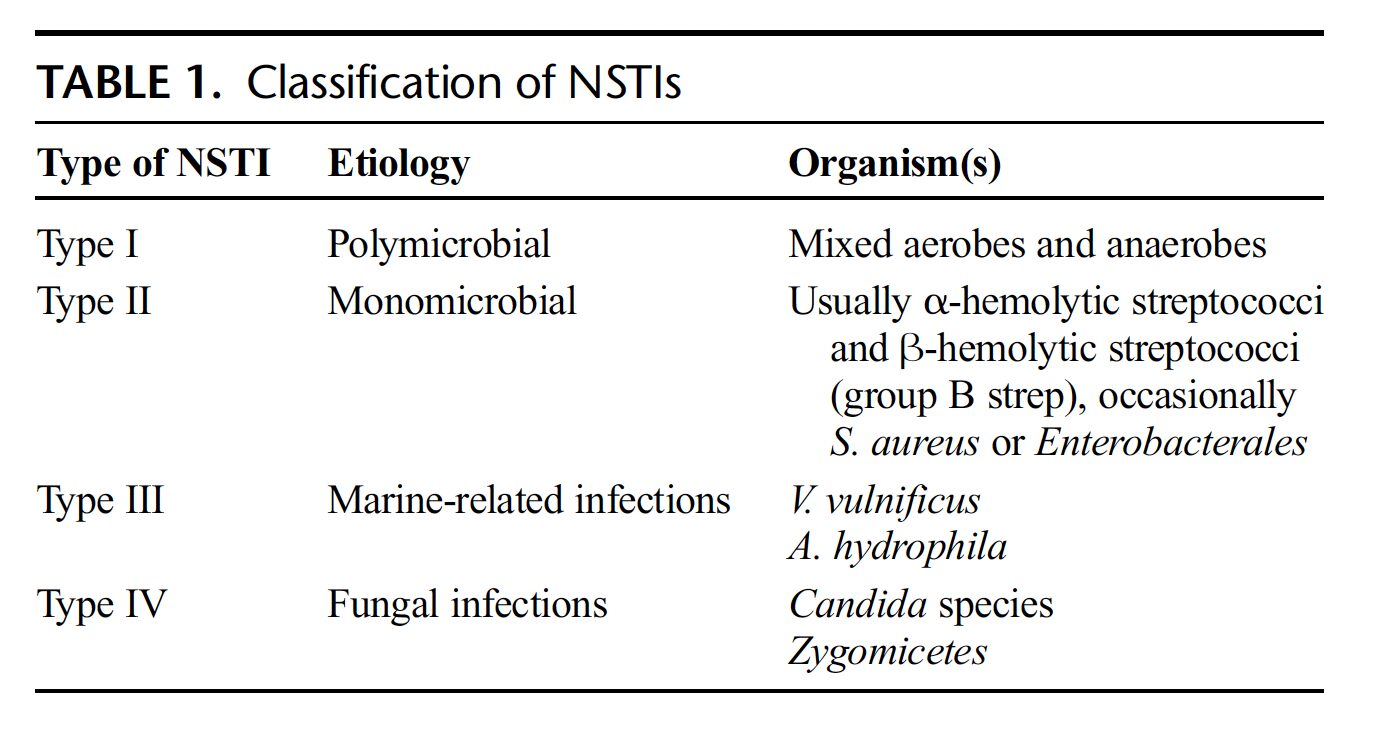
– There are four types of NSTI, but over 50% of NSTIs are polymicrobial (Type I). Type II is monomicrobial, and type III associated with marine-related infections. Type IV includes fungal infections.
– Obtain blood cultures in the ED. Deep tissue/operative cultures should be obtained when possible in the OR.
– Broad-spectrum antibiotics should be provided covering gram-positive, gram-negative, and anaerobic species at appropriate loading doses based on local susceptibilities. Cover MRSA as well (vancomycin, daptomycin, or linezolid).
– Antibiotics should provide toxin inhibition. This typically includes clindamycin, but linezolid may have similar effects on protein synthesis and can be considered in settings where there may be resistance to clindamycin.
– An appropriate initial regimen in the ED may include piperacillin-tazobactam, clindamycin, and vancomycin (given last if order is an issue). Extended-spectrum β-lactamase–producing Enterobacterales are becoming more common. If there is concern for these species, administer a carbapenem (meropenem 1-2 g every 8 hours). Concern for suspected carbapenem-resistant gram-negative bacteria warrants imipenem/cilastatin-relebactam 1.25 every 6 hours, meropenem/vaborbactam 2 g/2 g every 8 hours, or ceftazidime/avibactam 2.5 g every 8 hours plus metronidazole 500 mg every 8 hours.
5. Adjunctive Therapies
Hyperbaric oxygen (HBO) could be considered if available. Still, it should not interfere with nor delay the standard treatment, including aggressive ICU support and operative management as required (low-quality evidence, weak recommendation).
– HBO exposes patients to 100% oxygen at pressures > 101.3 kPA and has been studied as an adjunct to surgery and antibiotics. HBO may be considered if available.
– However, HBO should not delay other treatments (surgery and antibiotics), and transfer solely for HBO is probably not warranted.
Intravenous immunoglobulin (IVIG) therapy should be used to improve outcomes in a selected population of patients with NSTIs, including GAS-related NSTIs with STSS (low-quality evidence, weak recommendation).
– IVIG modulates inflammation through exotoxin binding and may be helpful in critically ill patients with Group A strep-related NSTIs.
Reltecimod is a new agent that has been studied for the modulation of inflammation after NSTIs. Further studies are warranted to establish its efficacy. No recommendation can be made.
Renal replacement therapy has been proposed to manage NSTIs. Further studies are warranted to establish its efficacy. No recommendation can be made.
– Further study is necessary on reltecimod (inhibits T-cell activation) and RRT.
6. Postoperative Wound Care
Negative pressure wound therapy (NPWT) after complete necrosis removal is a helpful option for wound care (low-quality evidence, strong recommendation).
– Multiple debridements are necessary but make wound care challenging. Specially trained wound care nurses are integral. Negative pressure wound therapy is helpful following debridement. Wound dressings should facilitate patient mobility. Plastic surgical closure and reconstruction are ideal following successful debridement.
7. Long-term Management
The large quantity of necrotic tissue debrided required to save the patient’s life often creates difficult challenges regarding wound care, preservation of function, reconstruction, and cosmesis. A multidisciplinary team approach should focus on survival and long-term functional outcomes (very low-quality evidence, strong recommendation).
– Long-term care is required with a multidisciplinary team that includes wound care, psychosocial support, and physical therapy. Focusing on long-term functional outcomes is important.
8. Fournier Gangrene
Treatment of FG includes prompt, appropriate antibiotic therapy, hemodynamic support, and early debridement (low-quality evidence, strong recommendation).
Early and extensive initial surgical debridement in FG patients improves survival (low-quality evidence, strong recommendation).
Fecal diversion, either by colostomy or fecal tube system with or without negative pressure therapy, should be considered in cases of FG. Diverting colostomy should be avoided as much as possible, mainly when other methods are available to prevent or decrease wound contamination (low-quality evidence, strong recommendation).
– FG is a rare, often polymicrobial infection of the perineum. It advances along clinical planes. Diagnosis is similar to other forms of NSTI, but imaging should not delay surgery or antibiotics.
– Urology consultation is often necessary for FG.
– Surgical considerations include fecal diversion.