
Medical Malpractice Insights: Death Happens
Chuck Pilcher evaluates a case of cardiac arrest and when a bad outcome does not necessarily mean negligence
Medical Malpractice Insights: Death Happens Read More »

Chuck Pilcher evaluates a case of cardiac arrest and when a bad outcome does not necessarily mean negligence
Medical Malpractice Insights: Death Happens Read More »
In this podcast with Dr. Eddy Lang and world expert troponin researcher Dr. Andrew McRae, we answer the not-so-simple questions…
EM Cases: Low Risk Chest Pain and High Sensitivity Troponin – A Paradigm Shift Read More »
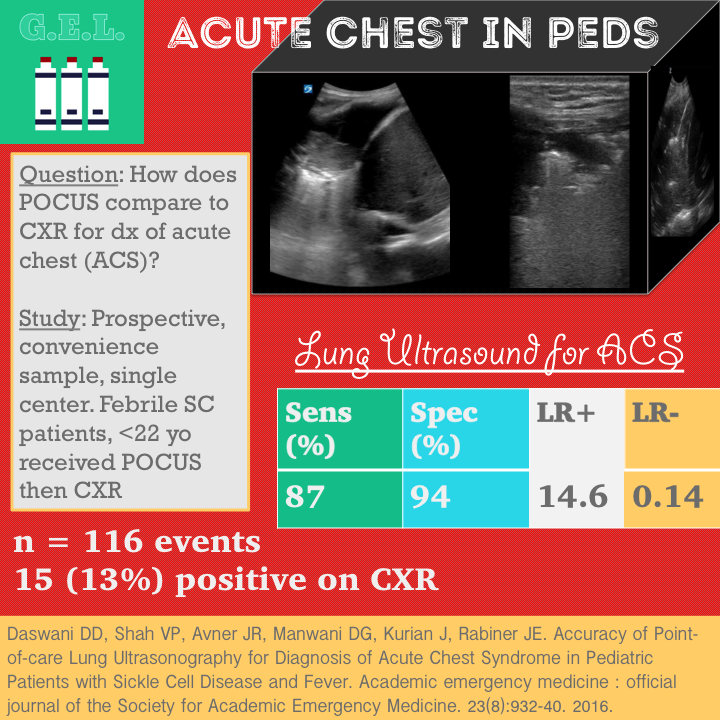
Can you do POCUS to detect acute chest syndrome?
Ultrasound G.E.L. – Acute Chest Syndrome in Pediatric Patients Read More »
CCTA has become a popular modality in the ED setting to assess anatomic atherosclerotic disease in patients presenting with chest pain. Advocates of CCTA feel that CCTA has a greater accuracy in identifying obstructive coronary artery disease and identification of high-risk disease compared to standard physiologic testing. However, many published trials on CCTA were not adequately powered to evaluate patient oriented end points.

If you haven’t heard of speckle tracking on echocardiography – it is a pretty cool idea. So maybe this Speckle Tracking echocardiography (STE) would be of use as a point-of-care study to help identify patients that need more emergent revascularization when acute coronary syndrome is suspected.
Ultrasound G.E.L. – Speckle Tracking for Acute Coronary Syndrome Read More »

Welcome to this week’s ECG Pointers, an emDOCs series designed to give you high yield tips about ECGs to keep your interpretation skills sharp. This week we discuss how to identify a posterior STEMI, which can commonly be mistaken as a NSTEMI.
ECG Pointers: Posterior MI Read More »
Often, when we see a RBBB in a chest pain patient, looking for ischemic changes may seem difficult as secondary repolarization abnormalities may be normal findings in V1-V3. So what can we do to help us in picking up ACS changes on the EKG in the setting of a RBBB?
ECG Pointers: RBBB in ACS Read More »

ACS may present in various fashions, and many other deadly conditions can mimic ACS. How can you differentiate these conditions? This post evaluates several diseases that appear similar to ACS.
ACS Mimics: ED Differential Diagnosis and Approach to Management Read More »

Not every patient with acute coronary syndrome presents with retrosternal chest pain. What are the atypical presentations of ACS, and how can we improve our diagnosis of the dangerous masqueraders?
Atypical ACS Presentations: How Can We Improve? Read More »

What other patient populations are at risk for developing atherosclerotic disease and ACS that emergency physicians can miss? If our community is responsible for recognizing and treating initial presentations of patients with ACS, we must not only be aware of atypical presentations of ACS, but also non-traditional risk factors for CHD.
Non-Traditional ACS Risk Factors: A Snake in the Grass Read More »