
Limitations of CIWA score
Welcome to the next Tox Card. Today we discuss CIWA score limitations.
Limitations of CIWA score Read More »

Welcome to the next Tox Card. Today we discuss CIWA score limitations.
Limitations of CIWA score Read More »

There are certain diseases we see every day in the ED, including pneumonia, UTI, and cellulitis. A variety of antimicrobials exists, but what are the regimens that you must know for treating common infections in the ED? This post evaluates your “must know” regimens for treatment.
Must Know Antimicrobial Regimens – Adults Read More »

If you’re like us, chances are that you’ve encountered the difficulty in evaluating a patient in the emergency department after seizure-like activity. Read on, contained within we offer a number of pearls for assessing this unique patient population.
Seizure Mimics: Pearls & Pitfalls Read More »

The decision between academic and community medicine can be difficult. Many who enter academic EM feel unprepared. This post discusses the difference between academic and community EM, and if you are interested in academic EM, pearls on succeeding in academics.
The Road to Academic Emergency Medicine Read More »
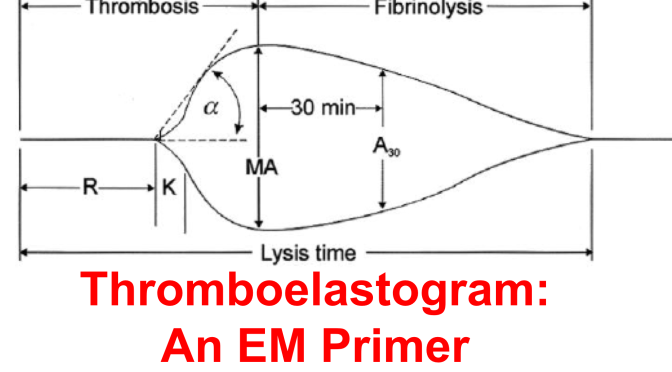
Thromboelastography is a mechanism of assessing coagulation based upon the viscoelastic properties of whole blood, and when compared to other coagulation assessments, this test allows for an assessment of near real-time, in-vivo clotting capacity. The point-of-care assay, which uses graphic interpretation of thromboelastography (the TEG), offers the opportunity for an expedited assessment of coagulopathies (thrombocytopenia, factor deficiency, heparin effect, hypofibrinogenemia, and hyperfibrinolysis). How can you use this modality in the ED? This post is full of pearls on interpreting TEG.
The Thromboelastogram (TEG®): A Five-Minute Primer for the Emergency Physician Read More »

Well appearing patients who present to the emergency department (ED) rarely have serious disease. However, there are some conditions that can cause otherwise healthy patients to rapidly deteriorate. This article reviews a few conditions that can affect otherwise healthy patients and how to diagnose and treat these patients in the ED.
Healthy Patients with Potential to Crash Read More »
Epinephrine is a key component of ACLS measures. But what does the data show? This post evaluates the ACLS recommendations for epinephrine in cardiac arrest, the literature behind its use, and future directions.
A Myth Revisited: Epinephrine for Cardiac Arrest Read More »

Having difficulty determining whether or not your GI bleeder is stable for the floor? Read on as we discuss risk stratification tools and risk factors for severe GI bleeds.
GI Bleeds: Who Needs ICU Level Care? Read More »

Human trafficking is a widespread problem in the US and emergency medicine physicians should be aware of how to recognize potential victims.
Human Trafficking in the ED: Pearls and Pitfalls Read More »
Managing Sexual Assault in the Emergency Department
This review will address patient stabilization, provide recommendations for obtaining a medical and assault history, and detail pregnancy and sexually transmitted infection prophylaxis. An in-depth discussion of the forensic examination will be omitted, as requirements regarding healthcare provider training, tools contained within forensic collection kits, time allotted between alleged assault and court admissible evidence collection, and chain of custody legislation vary according to individual state law.
Managing Sexual Assault in the Emergency Department Read More »