Author: Thomas Nguyen, MD (EM Resident, Carolinas Medical Center / Charlotte, NC) // Reviewed by: Erik Fisher, MD (EM Attending Physician, Carolinas Medical Center / Charlotte, NC); Brian Lewis, MD (Assistant Professor of Emergency Medicine, Michigan State University College of Human Medicine); Brit Long, MD (@long_brit)

Case:
A 32-year-old female presents to the ED with 2 hours of persistent nausea, vomiting, diarrhea, and dizziness since waking from sleep this morning. They report that they had prepared some wild mushrooms for dinner, approximately 9 hours ago. They report that they knew the mushroom was safe to eat because they had utilized a mushroom identification app on their phone which identified the mushroom as a morel; additionally, they had lightly sautéed the mushroom with garlic to determine whether it was edible. Triage VS: BP 98/64, HR 118, T 98.8, RR 24, SpO2 99% on room air.
What is the diagnosis?
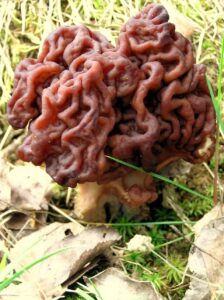
Answer: Gyromitrin toxicity due to wild mushroom/ “false morel” ingestion1-9
Questions:
- Why and how are individuals getting poisoned by mushrooms?
- How does someone identify mushrooms?
- Are commonly available phone applications reliable for mushroom identification?
- What is the acute approach to mushroom toxicity and treatment?
- Are there any antidotes available?
Background:
- Wild mushroom foraging is a hobby, with participants having variable expertise on mushroom identification
- Foragers looking for true morels (Morchella esculenta), which are reported to be a “choice edible”, can confuse them for toxic look-alikes, including Gyromitra spp.1
- Gyromitrin is a toxin found in these mushrooms2
- This is a carcinogen in animal studies9
- After repeat hydrolysis within the body, this compound yields monomethylhydrazine (MMH)
- Monomethylhydrazine reacts with pyridoxine, resulting in depletion of pyridoxine and impaired production of GABA2
- Responsible for CNS symptoms including seizures
- Same mechanism as isoniazid (isonicotinic acid hydrazide) toxicity
- Gyromitrin is a toxin found in these mushrooms2
- MMH is additionally hepatotoxic and nephrotoxic
- There are many erroneous tests used by novices and amateurs to determine the edibility of a mushroom3
- Some old cookbooks state that a poisonous mushroom will always turn onions or garlic black when cooked together
- Another widely printed false edibility test: “Sprinkle salt on the spongy part or gills of the mushroom, if yellow they are poisonous, if black they are nontoxic”
- Others believe that if they observe an animal eating the mushroom, that mushroom is non-toxic
- Squirrels have been observed to eat death cap mushrooms without ill effects4
- Phone applications are available to assist foragers with mushroom identification, but these misidentify mushrooms frequently5
- Hodgson SE et al. tested three different applications using actual images sent to a poison control center; showed poor accuracy across all of them, with 49% of mushroom specimens correctly identified compared to mycologist
- 44% of poisonous mushrooms were correctly identified, and 67% of Amanita phalloides (“death cap” mushrooms) correctly identified
- Enthusiasts also go on social media such as Facebook or Reddit to ask for help identifying their mushrooms from someone (hopefully) more experienced than they
- Mycologists utilize a variety of techniques other than physical features to identify mushrooms2,6
- Includes observations made about the habitat (substrate, associated trees, season, location), color changes with bruising, spore prints
- Also includes slide preparation and microscopy
- Based on life-cycle stage, physical features can vary greatly
- Epidemiology
- Peak incidence of gyromitrin poisoning is in the spring, as both Morchella spp. (true morel) and Gyromitra spp. (“false” morel) fruit at that time6
- Most exposures in North America are reported in the Midwest and Pacific Northwest, but most poisonings overall occur in Eastern Europe/Scandinavia where Gyromitra esculenta (sometimes known as “false morel”), despite containing gyromitrin, is sought after and eaten1,7
- Esculenta is from Latin, meaning “edible”
- The mushroom must be boiled multiple times (parboiled) to substantially reduce the concentration of the toxin, though it does not eliminate the toxin8
- It is additionally reported that fumes generated during boiling are also toxic, so it is recommended to do so in a well-ventilated area
Clinical Presentation:
- The time of symptom onset of gyromitrin toxicity is typically 5-10h post-ingestion2
- Early: GI symptoms including nausea, vomiting, diarrhea, abdominal pain
- Late: CNS symptoms including weakness, cramping, ataxia, delirium, seizures, coma
- These symptoms can present >24h post-ingestion
- Severe: status epilepticus, renal or liver failure
- Elevated LFTs peak at 4-5 days post-ingestion7
- Delayed symptoms post-ingestion of Gyromitra are thought to lead to worse outcomes, as there is no opportunity to vomit out the toxin
Diagnosis:
- Mushroom poisoning is a clinical diagnosis, and so it is crucial to obtain the history of mushroom ingestion10
- Delayed GI toxicity after consumption of mushrooms is classically concerning for a potentially lethal mushroom ingestion
- Other life-threatening mushroom toxins include amatoxin and orellanine, which also cause delayed GI symptoms6
- As toxic mushroom poisonings can look clinically similar in their early stages, an attempt to identify the mushroom can make management easier2
- Poison centers are associated with consultant mycologists that can help with identification
- Images of the mushroom are helpful; if patient has a sample of the mushroom remaining, that can also be used to identify it
- The differential should also include undercooked true morel ingestion, as even if identified correctly, true morels when undercooked or raw are also associated with illness including GI and neurologic symptoms11-12
Management:
- Laboratory workup for assessment of electrolytes, liver, and kidney function7
- CMP, PT/INR
- Supportive care including toxicology/poison control consultation
- Mild gyromitrin ingestions are typically self-resolving, as MMH is eliminated by acetylation in the liver
- Pyridoxine repletion helps prevent seizures by counteracting the mechanism of action of monomethylhydrazine2
- 70mg/kg IV, max 5g (similar to isoniazid poisoning)
- Benzodiazepines are additionally effective for seizures
- Special considerations:
- Does not appear to cross the placenta (based on case studies of poisoned pregnant women)
- In cases of severe liver and kidney damage, patients have been placed on dialysis, considered for liver transplantation
- If concern for amatoxin ingestion, administer activated charcoal for recent ingestions then start silibinin or cyclosporine
Case Follow-Up:
- The patient was loaded with pyridoxine and admitted under observation given a symptomatic ingestion of gyromitrin that was suspected to be large
- Supportive care continued for GI symptoms including fluids and antiemetics
- Patient had mild elevation in creatinine and LFTs which resolved on serial labs, discharged several days after admission in stable condition
Clinical Pearls:
- Edible mushrooms can be mistaken for toxic look-alikes, such as in this case with true and false morels; even if technically edible, they can be prepared incorrectly which can also result in illness
- Historical tests as well as new identification apps can falsely reassure foragers that the mushroom they are consuming is safe to eat
- Along with supportive care and monitoring of renal and hepatic markers, pyridoxine and benzodiazepines are helpful to treat seizures in gyromitrin toxicity
Further FOAMed:
References:
- Beug MW. Summary of the poisoning reports in the NAMA case registry for 2006 through 2017. McIlvainea. Available from: https://namyco.org/wp-content/uploads/2023/08/2006-2017_Summary_of_Mushroom_Poisoning_Reports.pdf
- Goldfrank LR. Mushrooms. In: Nelson LS, Howland MA, Lewin NA, Smith SW, Goldfrank LR, Hoffman RS, eds. Goldfrank’s Toxicologic Emergencies. 11th ed. New York, NY: McGraw-Hill Education; 2019:1581-1596.
- Philip RK. Enquire within upon everything. London: Houlston and Wright; 1865. Available from: https://archive.org/details/enquirewithinupo00phil_1
- Fogel R, Trappe JM. Fungus consumption (mycophagy) by small animals. Northwest Sci. 1978;52(1):1-31.
- Hodgson SE, McKenzie C, May TW, Greene SL. A comparison of the accuracy of mushroom identification applications using digital photographs. Clin Tox 2023; 61 (3): 166-172.
- White J, Weinstein SA, De Haro L, Bédry R, Schaper A, Rumack BH, Zilker T. Mushroom poisoning: A proposed new clinical classification. Toxicon. 2019 Jan;157:53-65. doi: 10.1016/j.toxicon.2018.11.007. Epub 2018 Nov 12. PMID: 30439442.
- Regina AC, Kong EL, Horowitz BZ. Gyromitra Mushroom Toxicity. [Updated 2024 Feb 9]. In: StatPearls [Internet]. Treasure Island (FL): StatPearls Publishing; 2026 Jan-. Available from: https://www.ncbi.nlm.nih.gov/books/NBK470580/
- Pasonen P, Suomi J, Hirvonen T. Gyromitriinin terveysriskien arviointi ja vähentämiskeinot korvasienissä [Evaluating health risks and means of reduction of gyromitrin in false morels]. Helsinki: Ruokavirasto; 2025. Ruokaviraston tutkimuksia 1/2025. Available from: https://helda.helsinki.fi/server/api/core/bitstreams/935ee988-d526-48dd-b156-ef91d9e13170/content
- Toth B, Patil K. Gyromitrin as a tumor inducer. Neoplasma. 1981;28(5):559-64. PMID: 7198186.
- Dimitrova T, Cherneva D, Mihalev K, et al. Amatoxin Intoxication and Wild Mushroom Poisoning: Current Advances in Diagnosis, Risk Stratification, and Clinical Management. Toxins 2026; 18 (216).
- Lagrange E, Vernoux JP. Warning on False or True Morels and Button Mushrooms with Potential Toxicity Linked to Hydrazinic Toxins: An Update. Toxins (Basel). 2020 Jul 29;12(8):482. doi: 10.3390/toxins12080482. Erratum in: Toxins (Basel). 2022 May 16;14(5):345. doi: 10.3390/toxins14050345. PMID: 32751277; PMCID: PMC7472412.
- Demorest H, Hinnenkamp R, Cook-Shimanek M, et al. Outbreak Linked to Morel Mushroom Exposure — Montana, 2023. MMWR Morb Mortal Wkly Rep 2024;73:219–225.