Authors: Kelly Olsen, MD, PhD (Emergency Medicine Resident, Carolinas Medical Center, Atrium Healthm); Kathryn Kopec, DO (Emergency Medicine Attending & Medical Toxicologist, Carolinas Medical Center, Atrium Health) // Reviewed by: Tony Spadaro, MD, MPH (Assistant Professor of Emergency Medicine, Medical Toxicology, and Addiction Medicine at University of Pennsylvania); Alex Koyfman, MD (@EMHighAK); Brit Long, MD (@long_brit)
Case:
A 24-year-old male with no significant past medical history presents to the Emergency Department with facial swelling, dyspnea, and rash that began 2 hours prior to arrival. He reports that he has been using a “Wolverine peptide stack” that he bought online to try to build muscle mass for several months. He self-administered a dose from a new vial for the first time approximately 30 minutes prior to symptom onset. His initial vital signs were: 110 bpm, 126/79 mmHg, 24 breaths/minute, 98% on RA, and 98.2 F. On physical exam, he has a diffuse erythematous blanching rash on his trunk and extremities and mild diffuse edema to his face most prominent in the periorbital region. There is no tongue or lip swelling. He was mildly tachypneic but with no respiratory distress, stridor, wheezing, rales, or rhonchi.
Questions:
- What do people mean when they say they are using “peptides?”
- What are the most commonly self-injected substances and where are patients sourcing them?
- What benefits are patients seeking from these treatments?
- What are the most common complications that emergency medicine physicians should be aware of?
Background:
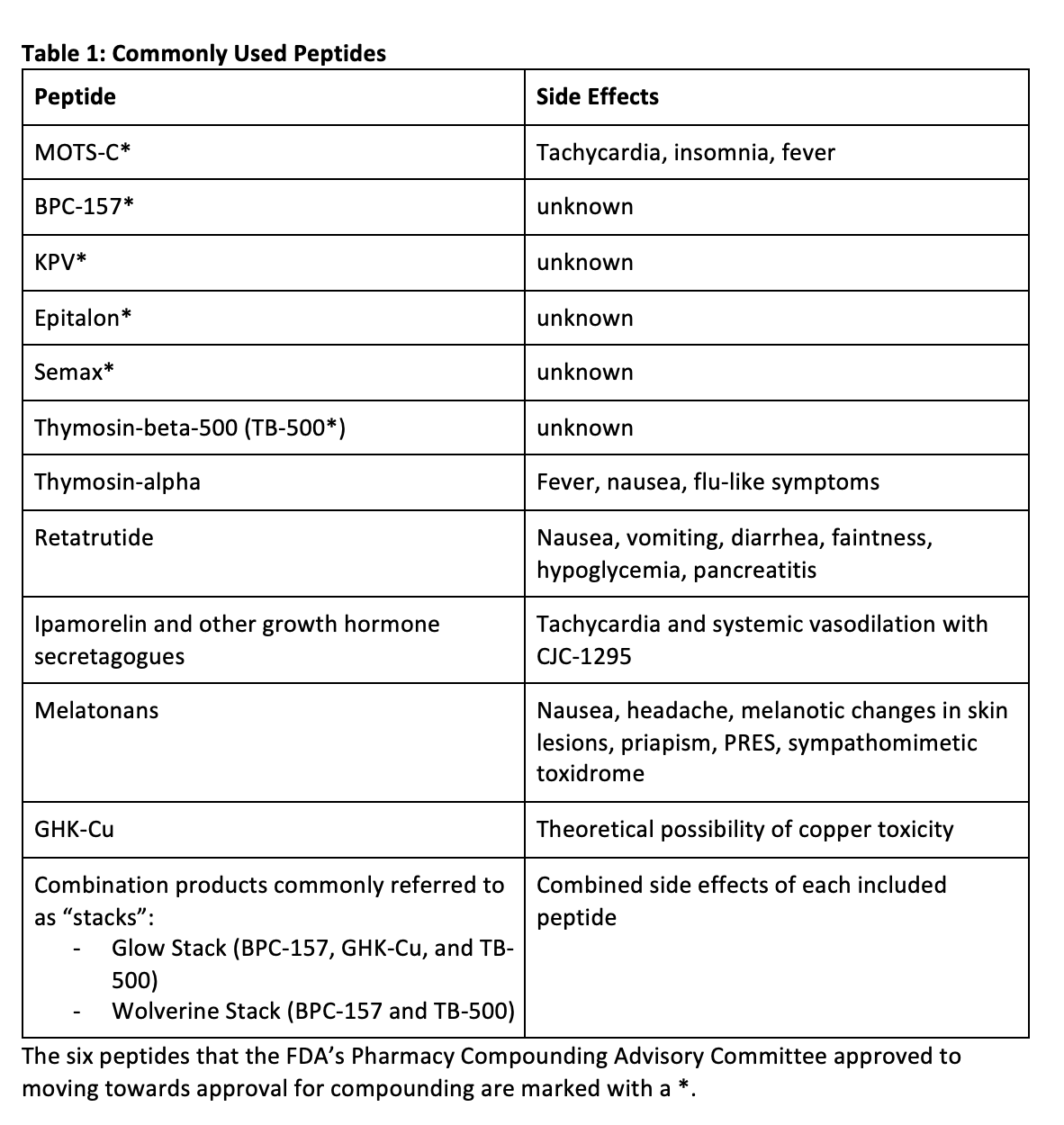
Peptides are short chains of 50 or fewer amino acids that have a variety of intrinsic functions in the body including acting as signaling molecules or as hormones.1,2 Peptide synthesis technologies emerged in the 1950s, leading to early synthetic peptide-based therapies including oxytocin and vasopressin.3 Peptides are attractive biopharmaceuticals due to their generally good safety profiles, high selectivity, and ease of synthesis compared to some traditional therapeutic agents.1 With the rise of GLP-1 medications, peptide therapies are more popular than ever, and nearly 100 peptide-based medications are now FDA approved.3 Interest in non-prescribed peptide utilization is also surging with a rise in the “biohacking” culture particularly within the fitness world. Health Secretary RFK Jr. is advocating for allowance of production of various peptides by compounding pharmacies to make them more widely accessible despite what the FDA describes as insufficient evidence to promote their use.4,5 In July 2026, six peptides passed a vote by the FDA’s Pharmacy Compounding Advisory Committee moving them towards approval for compounding.6 These included: BPC-157, MOTS-C, KPV, Epitalon, Semax, and TB-500.
Side effects of peptide-based therapeutics are dependent upon the specific peptide as well as manufacturing methods with some differences in synthetic versus animal-derived peptides. Common adverse events may be mediated by immunogenicity, including induction of cytokine secretion or stimulation of T cells, basophils, or neutrophils.1
Media sources estimate that thousands to tens of thousands of Americans are self-injecting peptides7,8. Bodybuilding communities, “biohacking” enthusiasts, and followers of fitness and wellness influencers are obtaining injectable peptides via grey-market sources with little mainstream and clinical information to guide them.2,9 Individuals typically purchase peptides labeled as “for research use only” either direct from factories, from importers/resellers, sellers on social media sites, or at wellness clinics.2,10 Once people receive a product and are ready to use it, they will typically reconstitute the lyophilized product with sterile water and self-inject, commonly with insulin syringes.10 While these products sometimes come with certificates of analysis or testing, it is important for consumers to be aware that they may not be authentic. There are labs that will perform independent testing after purchase, however, that can be time consuming and costly.11,12
What are the most commonly used peptides?
There is little data on peptide use demographics and trends given the unprescribed nature of these substances, so one must rely on public posts on social media or wellness sites to determine what peptides are being commonly utilized.
MOTS-C
- Mitochondrial rRNA-encoded peptide
- Enhances insulin sensitivity in skeletal muscle and appears to prevent high fat diet-induced obesity and insulin resistance in mice.13
- Suggested to work via promotion of fatty acid oxidation and inhibition of folate-dependent purine biosynthesis.14
- US Anti-Doping Agency has reported side effects include injection site irritation, tachycardia, insomnia, and fever.15
- No sufficient studies in humans
BPC-157 (Body Protective Compound-157)
- Synthetic peptide based on protein found in human gastric juice
- Promotes angiogenesis, fibroblast activity, endothelial and muscle repair, and anti-inflammatory effects via VEGFR2 and nitric oxide synthesis and ERK1/2 signaling.16
- Theorized to have effects in improving wound healing
- Proposed side effects based on in vitro evidence include the possibility of overproduction of nitric oxide, pathologic angiogenesis, and toxic metabolite formation, though no adverse effects were observed with high doses in animal models.16,17
- No sufficient studies in humans
KPV
- Tripeptide derived from C-terminal sequence of alpha-melanocyte stimulating hormone
- Reportedly inhibits proinflammatory cytokine production
- Individuals taking for believed effects on gut health and inflammation
- Improved colitis in mouse model, no human data available18
Epitalon
- Tetrapeptide that may impact lymphocyte differentiation and cytokine regulation19
- Theorized to have geroprotective “anti-aging” effects due to preservation of telomere length in cell culture20
- Sublingual Epitalon regulated circadian gene expression and enhanced melatonin production21
- No clinical data on injected Epitalon
Semax
- Heptapeptide derived from ACTH that upregulated brain-derived neurotropic factor (BDNF), which reportedly regulates neuroplasticity22
- Semax nasal spray has been utilized in Russia for neurological conditions including ischemic stroke, TIA, and optic nerve injury23
- Being studied in Russia for use in Alzheimer’s Disease24
- Russian studies report nasal cavity discoloration and increased blood glucose in diabetics as most common side effects with nasal spray25
- No US-based human data available
Thymosins
- Thymus-derived peptides that serve as immunomodulators
- Individuals utilizing for believed impacts on inflammation
- Thymosin alpha
- Likely functions via induction of IL-2 production, production of B cell growth factors, and increased efficacy of macrophage antigen presentation.26
- A synthetic analog of thymosin alpha 1, known as thymalfasin, is a therapeutic agent in other countries for chemotherapy-induced immunosuppression, chronic hepatitis B and C treatment, and to augment response to hepatitis and influenza vaccines in immunocompromised patients.26
- No FDA approved indications in the US
- Common adverse effects reported are injection site reactions, fever, nausea, and flu-like symptoms.27
- TB-500 (Thymosin beta 500)
- Derived from thymosin beta 4, one of the most abundant thymosins in human tissues.
- Plays a role in angiogenesis, attenuation of inflammation, and regulation of cell motility and differentiation.28
- Adverse effects are unknown, however, sites that promote its use discuss possible injection site reactions, headache, or fatigue.
Retatrutide
- Triple receptor agonist that targets glucagon-like peptide-1 (GLP1), glucagon, and glucose-dependent insulinotropic polypeptide (GIP) receptors.29
- Proposed use is for the treatment of obesity and T2DM
- Adverse effects are not fully known but mild GI effects have been reported.30 Phase III clinical trials recently completed, results not yet published.31
- Assuming similar action to prescribed GLP1 agents – could expect nausea, vomiting, generalized weakness, or abdominal pain, but in rare cases or overdose, hypoglycemia or acute pancreatitis may occur.32,33
Growth Hormone Secretagogues
- Utilized for increasing growth hormone (GH), leading to lean mass gain, fat mass loss, increased exercise tolerance, and increased muscle strength.23,34
- Does not cause negative feedback inhibition of natural GH production.34
- CJC-1295
- FDA reports that tachycardia and systemic vasodilatory reaction may occur.35
- One patient death from myocardial infarction in 2006 Phase II study for HIV-associated lipodystrophy, study was halted.36
- Ipamorelin
- One study investigating use for gastric motility had multiple serious adverse events including death in one patient, though causality was not established37
- Tesamorelin
- FDA-approved use for HIV-related lipodystrophy
- Most common adverse effects are injection site reaction, lipoatrophy, peripheral edema, and diarrhea.38
Melatonan I and II
- Synthetic peptide analog of alpha-melanocyte stimulating hormone
- Used for self-tanning purposes39
- Agonize melanocortin receptors, leading to increased tyrosinase activity causing melanin production and pigmentation.40
- Melatonan II also causes erection, increased libido, and reduced appetite.40
- Melatonan I is available as a pharmaceutical under the name afamelanotide and is used for patients with erythropoietic protoporphyria (EPP).
- Side effects include injection site reactions, nausea, and headaches41
- Rhabdomyolysis, priapism, sympathomimetic toxidromes, and posterior reversible encephalopathy syndrome (PRES) have all been reported with melatonan II use.42–45
- There has also been a rising number of reports of melanocytic alterations in existing moles and new dysplastic moles including four melanomas during or after melatonan I or II use.40,46
GHK-Cu (glycine-histidyl-lysine-copper)
- Copper-binding tripeptide
- Stimulates dermal fibroblast proliferation and collagen turnover and regulates matrix metalloproteases
- Widely studied in dermatology for wound healing and antiaging applications23.
- Trials of topical applications had no significant side effects but no human studies have been done with injected GHK-Cu.47
- Theoretical concern for excessive ingestion of copper with resultant toxicity
Several combination products are available through peptide sourcing sites, combining multiple peptides into a “stack” that are believed to be complementary in their effects.
Two commonly referenced stacks are:
- Wolverine Stack including BPC-157 and TB-500
- Intended by its users to augment musculoskeletal recovery and reduce inflammation.
- Glow Stack, including BPC-157, TB-500 and GHK-Cu
- Used to augment musculoskeletal recovery, reduce inflammation and increase collagen production.
Given these peptides are already often derived from sites with no approval for human use, sometimes dubious content analysis and purity testing, and limited evidence to support their safety and efficacy in human use, combination products theoretically increase the risk for adverse effects given the possibility for contamination, unanticipated concentrations of the components, or immunogenicity.
Adverse Effects: Clinical Presentation & Diagnosis
The incidence of ED clinical presentations secondary to peptide self-injection are unknown and may be hard to recognize or prove. A thorough history will be most important in management of patients that self-inject peptides, as patients may be reluctant to disclose this non-approved treatment they are using. They also may not think to report peptide use when asked about medications as they consider them supplements or natural products. Asking specifically about supplements, over the counter substances, and alternative therapies may be helpful
Recommended workup includes:
- Take a thorough history including time of injection and timeline of symptoms.
- Look for signs of systemic or local infection or anaphylaxis on physical exam
- Including rash particularly on common injection sites like abdomen or thigh, angioedema, wheezing, or stridor.
- Assess for altered vital signs.
- Consider lab work if the patient is unstable or if concerned for other clinical conditions
- Labs may not be necessary if you suspect a straightforward allergic reaction.
Possible unusual symptoms expected with specific peptides are discussed above. In general, it is likely that the most common symptoms may include:
- Injection site reactions – erythema and swelling
- Allergic reactions – rashes, erythema, swelling, dyspnea
- Traditional, FDA-approved peptide-based therapeutics typically have fewer side effects than classical pharmaceutical agents due to their small size and high selectivity, but still may be immunogenic.3
- It is unknown whether this will hold true for these unapproved substances.
- Traditional, FDA-approved peptide-based therapeutics typically have fewer side effects than classical pharmaceutical agents due to their small size and high selectivity, but still may be immunogenic.3
- Injection site infections
- Risk is higher in cases where substances injected are not approved for human use, have variable degrees of product testing, and reconstitution and administration occur by individuals with no medical training.
- Concern for contamination is high, though no data exists as of yet on what common contaminants may be in these products.
Management:
With the limited number of cases and adverse effects reported in the literature symptom management and supportive care are the current mainstay of treatment. Providers can tailor therapy to presenting symptoms.
- Allergic reaction-type symptoms may be one of the more common presenting symptoms and should likely be treated like a standard allergic reaction with antihistamines and steroids. For anaphylaxis, intramuscular epinephrine should be given.
- If there is clinical concern for injection site infection can consider antibiotics and updating tetanus status
Patients with mild reactions with symptomatic improvement may be discharged with instructions to follow up with their primary care doctor or an allergist, and to discontinue peptide use.
- Adverse events associated with peptide use should be reported to a regional poison center (1-800-222-1222) or a local medical toxicologist for public health surveillance and identification of clusters of cases that may occur with compounded peptides.
Case Conclusion:
The patient was treated with diphenhydramine and steroids. He was observed in the ED for 4 hours during which his rash and facial swelling resolved and his dyspnea improved. He was discharged home with recommendations to not use any further peptides.
Clinical Pearls:
- Take a rigorous, nonjudgmental history from patients including history of self-administered or wellness treatments. Patients may not initially disclose their peptide use.
- Peptides can be purchased from various sources with unknown quality control and testing. Contamination is also possible. The actual content may be a different substance the patient expected.
- Injection site reactions or allergy-like reactions may occur.
- Symptoms will vary based on substance utilized; consider the mechanism of the substance, though remember that what a patient injected may not be what they intended to use.
- Treatment is aimed at supportive care and symptomatic treatment, and may include antihistamines or steroids for allergic reactions or epinephrine for anaphylaxis.
References:
- Deptuła M, Wardowska A, Dzierżyńska M, Rodziewicz-Motowidło S, Pikuła M. Antibacterial Peptides in Dermatology–Strategies for Evaluation of Allergic Potential. Mol J Synth Chem Nat Prod Chem. 2018;23(2):414. doi:10.3390/molecules23020414
- Hailu KT, Abriha FN, Duguma YM, et al. Unregulated Peptide Use in the Age of Biohacking: Digital Promotion, Gray-Market Access, and Emerging Public Health Risks. Cureus. 2026;18. doi:10.7759/cureus.110657
- Xiao W, Jiang W, Chen Z, et al. Advance in peptide-based drug development: delivery platforms, therapeutics and vaccines. Signal Transduct Target Ther. 2025;10(1):74. doi:10.1038/s41392-024-02107-5
- RFK Jr. wants to make it easier to get peptides. FDA scientists disagree. NBC News. 30 June 2026. Accessed 14 July 2026. https://www.nbcnews.com/health/health-news/rfk-jr-wants-make-easier-get-peptides-fda-scientists-disagree-rcna352323
- Stone W. FDA scientists flag concerns with peptides, the trendy molecules RFK Jr. supports. NPR. 30 June 2026. Accessed 23 August 2026. https://www.npr.org/2026/06/30/nx-s1-5876301/peptides-fda-panel-compounding-rfk
- Peptides: US advisory committee recommends six for FDA “compounding list” | The BMJ. Accessed 28 July 2026. https://www.bmj.com/content/394/bmj-2026-100422
- Mosbergen D. What to Know About the ‘Anti-Aging’ Peptide Shots Flooding Social Media. TIME. 24 February 2026. Accessed 29 July 2026. https://time.com/7380810/anti-aging-peptide-shots-social-media/
- US TW. The peptide craze. The Week. 20 July 2026. Accessed 29 July 2026. https://theweek.com/health/the-peptide-craze
- Brennan R, Wells JSG, Van Hout MC. The injecting use of image and performance-enhancing drugs (IPED) in the general population: a systematic review. Health Soc Care Community. 2017;25(5):1459-1531. doi:10.1111/hsc.12326
- ‘Chinese Peptides’ Are the Latest Biohacking Trend in the Tech World – The New York Times. Accessed 14 July 2026. https://www.nytimes.com/2026/01/03/business/chinese-peptides-silicon-valley.html
- Freedom Diagnostics Testing. Freedom Diagnostics Testing. Accessed 14 July 2026. https://freedomdiagnosticstesting.com/
- Trusted Laboratory Testing of Anabolics, Peptides and More. JANOSHIK. Accessed 14 July 2026. https://janoshik.com/
- Lee C, Zeng J, Drew BG, et al. The Mitochondrial-Derived Peptide MOTS-c Promotes Metabolic Homeostasis and Reduces Obesity and Insulin Resistance. Cell Metab. 2015;21(3):443-454. doi:10.1016/j.cmet.2015.02.009
- Mendias CL, Awan TM. Safety and Efficacy of Approved and Unapproved Peptide Therapies for Musculoskeletal Injuries and Athletic Performance. Sports Med. Published online 12 April 2026. doi:10.1007/s40279-026-02437-0
- What is the MOTS-c peptide? | USADA. 16 January 2024. Accessed 17 July 2026. https://www.usada.org/spirit-of-sport/what-is-mots-c-peptide/
- McGuire FP, Martinez R, Lenz A, Skinner L, Cushman DM. Regeneration or Risk? A Narrative Review of BPC-157 for Musculoskeletal Healing. Curr Rev Musculoskelet Med. 2025;18(12):611-619. doi:10.1007/s12178-025-09990-7
- Xu C, Sun L, Ren F, et al. Preclinical safety evaluation of body protective compound-157, a potential drug for treating various wounds. Regul Toxicol Pharmacol. 2020;114:104665. doi:10.1016/j.yrtph.2020.104665
- Dalmasso G, Charrier-Hisamuddin L, Nguyen HTT, Yan Y, Sitaraman S, Merlin D. PepT1-Mediated Tripeptide KPV Uptake Reduces Intestinal Inflammation. Gastroenterology. 2008;134(1):166-178. doi:10.1053/j.gastro.2007.10.026
- Araj SK, Brzezik J, Mądra-Gackowska K, Szeleszczuk Ł. Overview of Epitalon—Highly Bioactive Pineal Tetrapeptide with Promising Properties. Int J Mol Sci. 2025;26(6):2691. doi:10.3390/ijms26062691
- Al-dulaimi S, Thomas R, Matta S, Roberts T. Epitalon increases telomere length in human cell lines through telomerase upregulation or ALT activity. Biogerontology. 2025;26(5):178. doi:10.1007/s10522-025-10315-x
- Ivko OM, Linkova NS, Ilina AR, Sharova AA, Ruzhak GA. AEDG Peptide Regulation of the Expression of Human Circadian Rhythm Genes upon Accelerated Aging of the Pineal Gland. Adv Gerontol. 2021;11(1):53-58. doi:10.1134/S2079057021010380
- Mavrych V, Shypilova I, Bolgova O. Therapeutic peptides in gerontology: mechanisms and applications for healthy aging. Front Aging. 2026;7. doi:10.3389/fragi.2026.1790247
- Rahman OF, Lee SJ, Seeds WA. Therapeutic Peptides in Orthopaedics: Applications, Challenges, and Future Directions. JAAOS Glob Res Rev. 2026;10(1):e25.00236. doi:10.5435/JAAOSGlobal-D-25-00236
- Radchenko AI, Kuzubova EV, Apostol AA, et al. The Potential of the Peptide Drug Semax and Its Derivative for Correcting Pathological Impairments in the Animal Model of Alzheimer’s Disease. Acta Naturae. 2025;17(4):110-120. doi:10.32607/actanaturae.27808
- Kolomin T, Shadrina M, Slominsky P, Limborska S, Myasoedov N. A New Generation of Drugs: Synthetic Peptides Based on Natural Regulatory Peptides. Neurosci Med. 2013;04(04):223-252. doi:10.4236/nm.2013.44035
- Dominari A, Hathaway III D, Pandav K, et al. Thymosin alpha 1: A comprehensive review of the literature. World J Virol. 2020;9(5):67-78. doi:10.5501/wjv.v9.i5.67
- Rhode Island Hospital. A Pilot Trial of Thymalfasin (Ta1) to Treat COVID-19 Infection in Patients With Lymphocytopenia. clinicaltrials.gov; 2023. Accessed 17 July 2026. https://clinicaltrials.gov/study/NCT04487444
- Di H, Huang J, Zhang D, Ni F, Zheng R, Geng H. Thymosin beta 4: An emerging therapeutic candidate for kidney diseases. Peptides. 2026;195:171467. doi:10.1016/j.peptides.2026.171467
- Katsi V, Koutsopoulos G, Fragoulis C, Dimitriadis K, Tsioufis K. Retatrutide—A Game Changer in Obesity Pharmacotherapy. Biomolecules. 2025;15(6):796. doi:10.3390/biom15060796
- Coskun T, Urva S, Roell WC, et al. LY3437943, a novel triple glucagon, GIP, and GLP-1 receptor agonist for glycemic control and weight loss: From discovery to clinical proof of concept. Cell Metab. 2022;34(9):1234-1247.e9. doi:10.1016/j.cmet.2022.07.013
- Eli Lilly and Company. A Master Protocol to Investigate the Efficacy and Safety of LY3437943 Once Weekly in Participants With Type 2 Diabetes Mellitus Who Have Obesity or Overweight: A Randomized Double-Blind, Placebo-Controlled Trial. clinicaltrials.gov; 2026. Accessed 17 July 2026. https://clinicaltrials.gov/study/NCT05929079
- AlSaadoun AR, AlSaadoun TR, Al Ghumlas AK. Liraglutide Overdose-Induced Acute Pancreatitis. Cureus. 14(1):e21616. doi:10.7759/cureus.21616
- Marshall S, Ryan E, Rivera J, Reynolds L, Atti S. GLP-1 Receptor Agonist Exposures Are Increasingly Common and Generally Associated with Mild Symptoms: A Single Poison Center Experience. J Med Toxicol. 2024;20(3):278-285. doi:10.1007/s13181-024-01008-x
- Sigalos JT, Pastuszak AW. The Safety and Efficacy of Growth Hormone Secretagogues. Sex Med Rev. 2018;6(1):45-53. doi:10.1016/j.sxmr.2017.02.004
- Research C for DE and. Certain Bulk Drug Substances for Use in Compounding that May Present Significant Safety Risks. FDA. Published online 27 April 2026. Accessed 17 July 2026. https://www.fda.gov/drugs/human-drug-compounding/certain-bulk-drug-substances-use-compounding-may-present-significant-safety-risks
- ConjuChem. A Multicenter, Randomized, Placebo-Controlled, Double-Blind, Phase 2 Study to Evaluate the Efficacy and Safety of CJC 1295 Administered for 12 Weeks in HIV Infected Patients With HIV Associated Visceral Obesity. clinicaltrials.gov; 2006. Accessed 29 July 2026. https://clinicaltrials.gov/study/NCT00267527
- Beck DE, Sweeney WB, McCarter MD, Ipamorelin 201 Study Group. Prospective, randomized, controlled, proof-of-concept study of the Ghrelin mimetic ipamorelin for the management of postoperative ileus in bowel resection patients. Int J Colorectal Dis. 2014;29(12):1527-1534. doi:10.1007/s00384-014-2030-8
- Falutz J, Potvin D, Mamputu JC, et al. Effects of tesamorelin, a growth hormone-releasing factor, in HIV-infected patients with abdominal fat accumulation: a randomized placebo-controlled trial with a safety extension. J Acquir Immune Defic Syndr. 2010;53(3):311-322. doi:10.1097/QAI.0b013e3181cbdaff
- Langan EA, Nie Z, Rhodes LE. Melanotropic peptides: more than just ‘Barbie drugs’ and ‘sun‐tan jabs’? Br J Dermatol. 2010;163(3):451-455. doi:10.1111/j.1365-2133.2010.09891.x
- Habbema L, Halk AB, Neumann M, Bergman W. Risks of unregulated use of alpha‐melanocyte‐stimulating hormone analogues: a review. Int J Dermatol. 2017;56(10):975-980. doi:10.1111/ijd.13585
- Scenesse | European Medicines Agency (EMA). 1 December 2015. Accessed 17 July 2026. https://www.ema.europa.eu/en/medicines/human/EPAR/scenesse
- Nelson ME, Bryant SM, Aks SE. Melanotan II injection resulting in systemic toxicity and rhabdomyolysis. Clin Toxicol. 2012;50(10):1169-1173. doi:10.3109/15563650.2012.740637
- Devlin J, Pomerleau A, Foote J. Melanotan II overdose associated with priapism. Clin Toxicol. 2013;51(4):383-383. doi:10.3109/15563650.2013.784775
- Dreyer BA, Amer T, Fraser M. Melanotan-induced priapism: a hard-earned tan. BMJ Case Rep. 2019;12(2):e227644. doi:10.1136/bcr-2018-227644
- Kaski D, Stafford N, Mehta A, Jenkins IH, Malhotra P. Melanotan and the Posterior Reversible Encephalopathy Syndrome. Ann Intern Med. 2013;158(9):707-708. doi:10.7326/0003-4819-158-9-201305070-00020
- Paurobally D, Jason F, Dezfoulian B, Nikkels AF. Melanotan‐associated melanoma. Br J Dermatol. 2011;164(6):1403-1405. doi:10.1111/j.1365-2133.2011.10273.x
- Pickart L, Margolina A. Regenerative and Protective Actions of the GHK-Cu Peptide in the Light of the New Gene Data. Int J Mol Sci. 2018;19(7):1987. doi:10.3390/ijms19071987