External Ear Lacerations
Lacerations and injuries are pervasive in the Pediatric ED.
External Ear Lacerations Read More »

Lacerations and injuries are pervasive in the Pediatric ED.
External Ear Lacerations Read More »
A 3-year-old male is brought in by his mother for severe throat pain and lethargy. She notes that he is playing less, refusing to eat, and preferring to lie supine. Review of systems is remarkable for a recent small fall with his toothbrush in his mouth. Triage vital signs include BP 91/49, HR 141, T 103.1 temporal, RR 25, SpO2 96% on room air. He appears toxic and is lying supine. The oropharyngeal exam is normal, but the patient has prominent generalized cervical lymphadenopathy, torticollis, and a painful tracheal rock. The patient has no voice changes but does not want to extend his neck. What’s the most likely diagnosis?
EM@3AM: Retropharyngeal Abscess Read More »
A 23-year-old male presents for severe throat pain and cough. He states that his neck hurts, with left sided redness and pain. Vital signs include BP 91/49, HR 130, T 102.2 temporal, RR 25, SpO2 91% on room air. He appears toxic. The ENT exam reveals a midline uvula; soft mouth floor; prominent generalized cervical, submandibular, and submental swelling with corresponding lymphadenopathy; but no voice changes or difficulty tolerating secretions. His neck is red and tender, with mild swelling overlying the left side of neck and a painful tracheal rock. What is the most likely diagnosis?
EM@3AM: Lemierre’s syndrome Read More »
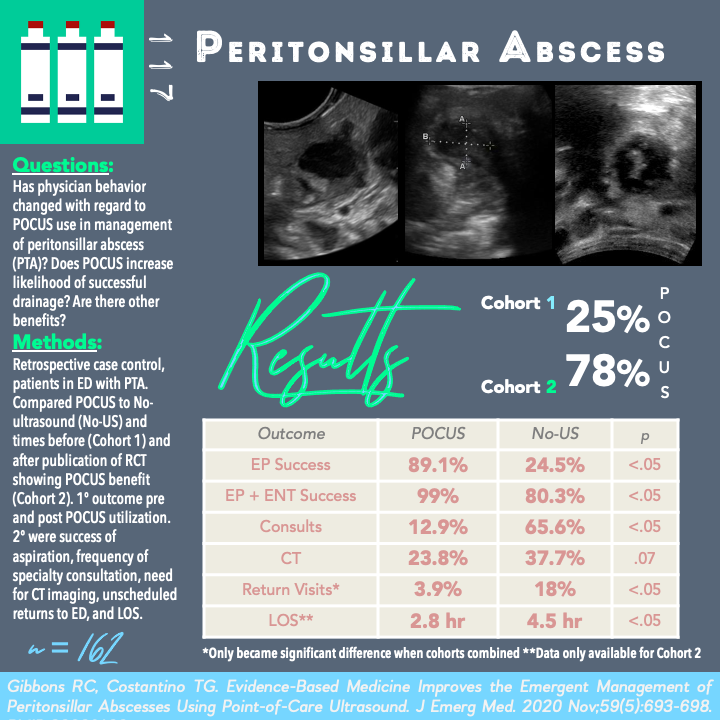
Do you use ultrasound for suspected peritonsillar abscess (PTA)? Some of us probably do, some don’t – but what does the evidence say?? Does it help the clinician? and (dare we ask) does it help the patient? This paper is potentially the best data we currently have on the topic. Mike and special guest Kim Fender dive straight into the purulence of this fluctuant topic.
Ultrasound G.E.L. – POCUS for Peritonsillar Abscess Read More »
An 8-year-old male presents after falling onto an outstretched hand. He has an obvious dinner fork deformity to the right forearm. X-ray confirms a fracture of the distal radius and ulna. You prepare for procedural sedation with ketamine while you reduce and splint the fracture. You run through the pre-sedation assessment and exam, then gather all medications and airway supplies. Once the ketamine is pushed you hear a high-pitched stridor and see the patient’s chest rise and fall irregularly as his oxygen saturation drops. What is the diagnosis and management?
EM@3AM: Laryngospasm Read More »
A 12-year-old boy with no past medical history accidentally ingested a soda can tab 2.5 hours prior to arrival. He is asymptomatic at present, feels well, and is able to tolerate secretions without difficulty. On exam, the patient is alert, acyanotic, and non-stridulous. Breath sounds are clear to auscultation bilaterally, and his abdomen is nontender. What evaluation is necessary, and what is the appropriate management?
EM@3AM: Beverage Tab Ingestion Read More »

Rachel Bridwell is back to discuss another ENT emergency: peritonsillar abscess.
emDOCs Podcast: Episode 34 – Peritonsillar Abscess Read More »
This week Rachel Bridwell and Brit Long cover Ludwig’s Angina, a potential ENT and airway nightmare.
emDOCs Podcast: Episode 33 – Ludwig’s Angina Read More »

Patients with head and neck cancer can experience several major complications. What do you need to know?
ED Care of Head and Neck Cancer Patients Read More »
A 31-year-old female presents with right ear pain and decreased hearing. Her symptoms started suddenly after trying to clean her ears with a Q-tip. She denies vertigo, nausea, vomiting, or other facial symptoms. On examination, you see a small perforation in the tympanic membrane (TM) with no discharge or other trauma.
What is your next step in evaluation and management?
EM@3AM: Tympanic Membrane Rupture Read More »