Author: Natalie Browne, MD (Emergency Medicine Resident, Atrium Health Carolinas Medical Center, Charlotte, NC) and Ann-Jeannette Geib, MD (Medical Toxicology/Emergency Medicine Faculty, Atrium Health Carolinas Medical Center, Charlotte, NC) // Reviewed by: Tony Spadaro, MD, MPH (Assistant Professor of Emergency Medicine, Medical Toxicology, and Addiction Medicine at University of Pennsylvania); Alex Koyfman, MD (@EMHighAK); Brit Long, MD (@long_brit)

Case:
A 68-year-old woman presents to her primary care physician with persistent jaw pain and difficulty chewing for the past 3 weeks. She reports that the pain began after having a tooth extraction, and the area has not healed properly. She denies fever or recent trauma.
Her medical history is significant for postmenopausal osteoporosis. She takes a weekly medication for this condition, along with calcium and vitamin D. On physical exam, there is an area of exposed bone (see picture below) along the right mandible with surrounding mild erythema but no purulent drainage.
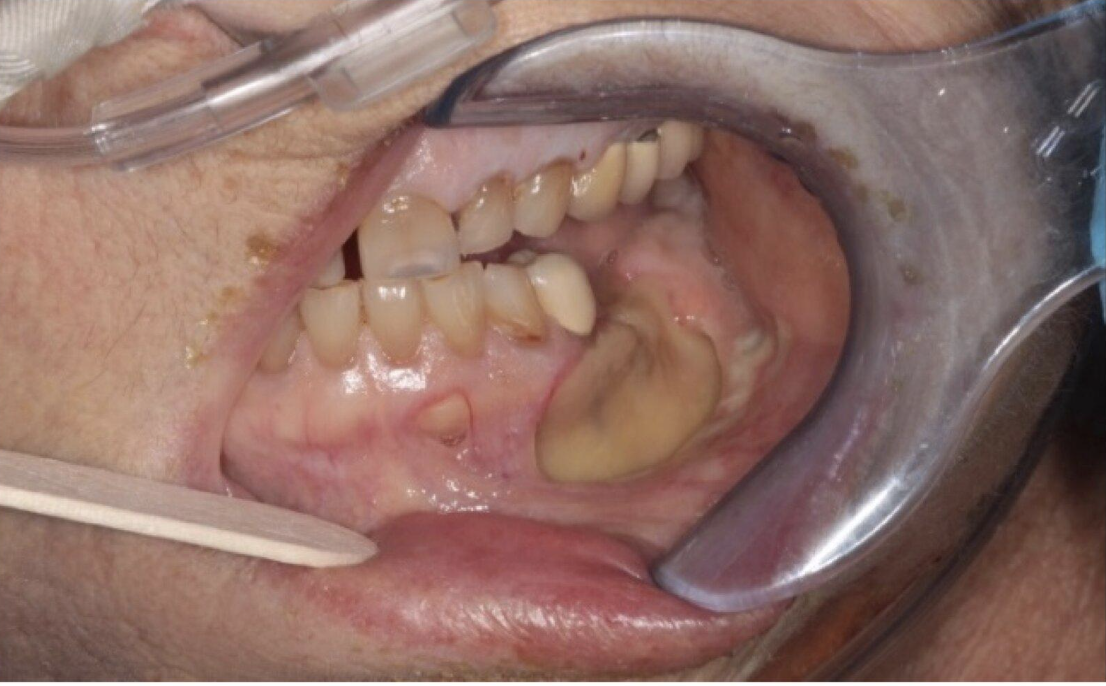
Image Source: Qaisi M, Hargett J, Loeb M, Brown J, Caloss R. Denosumab-related osteonecrosis of the jaw with spontaneous necrosis of the soft palate: report of a life-threatening case. Case Rep Dent. 2016;2016:5070187. doi:10.1155/2016/5070187
Questions:
Which medications used to treat osteoporosis are most commonly associated with the development of osteonecrosis?
What is the mechanism for bisphosphonate induced osteonecrosis?
What is the management of bisphosphonate osteonecrosis?
Background:
- Bisphosphonates are a class of drugs that help slow bone breakdown and reabsorption through inhibition of osteoclasts. Other drugs can also cause osteonecrosis, including corticosteroids, methotrexate, mechanistic target of rapamycin (mTOR) inhibitors, and CD4/6 inhibitors.1,2
- Bisphosphonates are first-line medications for the treatment of osteoporosis and to prevent fractures in post-menopausal women and men who are at high risk for fractures. Individuals who are at high risk include those taking glucocorticoids, those with cancer-related bone diseases, and those with Paget’s disease.2
- Bisphosphonates work by inhibiting bone resorption. There are two bisphosphonate classes: nitrogen-containing bisphosphonates and non-nitrogen-containing bisphosphonates. Both classes of medications have a similar initial mechanism of action by selectively binding to the bone mineral surface. These medications are then taken up by osteoclasts during bone resorption.3
- The nitrogen-containing bisphosphonates (NCBs) inhibit farnesyl pyrophosphate synthase, which is a key enzyme in the mevalonate/cholesterol biosynthesis pathways. By doing this, NCBs prevent the synthesis of lipids required for post-translational prenylation of small GTPase signaling proteins that are essential for osteoclast survival.3
- Non-nitrogen-containing bisphosphonates are metabolically incorporated into non-hydrolyzable analogs of ATP, which inhibit ATP-dependent intracellular enzymes and induce osteoclast apoptosis.3
How do bisphosphonates cause osteonecrosis?
- There are multiple ways bisphosphonates cause osteonecrosis, but it is primarily related to the over-suppression of bone remodeling and impaired mucosal wound healing.4
- The induction of osteoclast apoptosis and suppression of osteoclast activity impairs bone healing and remodeling.4
- Osteonecrosis is most commonly seen in the jaw because it has higher baseline remodeling rates compared to other bones, which makes it vulnerable when bone remodeling is suppressed. Osteolysis is a defense mechanism against infection on bone surfaces, and blocking osteolysis increases the risk of infection in those areas.4
- Poor wound healing and angiogenesis also contribute to osteonecrosis of the jaw (ONJ). Bisphosphonates also have an adverse effect on endothelial cells and fibroblasts and have antiangiogenic properties. A decrease in bone vascularity slows the jaw’s vascularization and wound healing capacity.4
- The route of administration can also impact the risk of developing osteonecrosis, with nitrogen-containing bisphosphonates being more potent and intravenous formulations having a higher incidence compared to oral formulations. Zoledronate has shown to have the highest risk of developing osteonecrosis.4
Clinical Presentation:
- Osteonecrosis of the jaw (ONJ) is primarily a clinical diagnosis. According to the American Association of Oral and Maxillofacial Surgeons (AAOMS), diagnosis requires three findings: current or prior treatment with an antiresorptive or antiangiogenic agent; exposed bone (or bone that can be probed through a fistula) in the maxillofacial region persisting for more than 8 weeks; and no history of radiation therapy or metastatic disease to the jaw.5
- Clinical features include exposed necrotic bone, fistulas probing to bone, dull jaw pain or odontalgia, soft tissue swelling, erythema, purulent drainage, loosening of teeth not attributable to periodontal disease, and trismus.
Diagnosis:
- Imaging is not required for diagnosis but can help with staging and may include panoramic radiographs, periapical films, CT, or MRI.
- Conditions that may mimic ONJ include alveolar osteitis, sinusitis, periodontitis, periapical disease, chronic osteomyelitis, fibro-osseous lesions, and malignancy.5
- The AAOMS has a staging system that classifies ONJ into an “at-risk” category and Stages 0 through 3 based on the presence and extent of bone exposure, symptoms, infection, and complications.5
- At-risk patients have a history of antiresorptive therapy without exposed bone and require only education.
- Stage 0 presents without exposed bone but with nonspecific symptoms (jaw pain, tooth pain, paresthesia) or radiographic changes. Stage 1 involves asymptomatic exposed necrotic bone or a fistula probing to bone without infection. Stage 2 includes exposed bone with infection (pain, erythema, purulence). Stage 3 is defined by exposed bone with infection plus complications such as pathologic fracture, extraoral fistula, or extension beyond the alveolar bone.5
Management:
- Treatments are usually dependent on the severity of osteonecrosis (stages 0-3). Early stages (stages 0-2) of disease are managed with conservative measures, which include antimicrobial mouth rinses, systemic antibiotic therapy for infection, pain control, and good oral h Antibiotic options include amoxicillin-clavulanate or a combination of a penicillin and metronidazole. For patients with a penicillin allergy, alternatives may include clindamycin or a fluoroquinolone.
- For more severe stages or failed conservative management, the treatment is usually surgical, most commonly through bone resection and debridement. Fortunately, these cases rarely require emergent surgical intervention, and most patients presenting to the ED can be managed with outpatient follow-up with their oral and maxillofacial surgery (OMFS) or dental team. Patients should also be counseled against discontinuing the offending medication without first discussing it with their prescribing physician, as these medications often play a critical role in managing conditions such as bone malignancies, multiple myeloma, and severe osteoporosis.6
Case Follow-up:
The patient was diagnosed with alendronate induced osteonecrosis of the jaw. Her alendronate was stopped and OMFS was consulted. She was admitted for ongoing pain control and antibiotics.
Clinical Pearls:
- Patients presenting with jaw pain, exposed bone, or nonhealing oral lesions (especially after dental procedures) should raise concern for ONJ if they have a history of bisphosphonate (e.g., osteoporosis, cancer) or antiangiogenic therapy.
- ONJ is a clinical diagnosis requiring antiresorptive/antiangiogenic use, bone exposure (or probe-to-bone via fistula) for greater than 8 weeks, and no prior jaw radiation. Imaging (CT, X-ray) helps stage and assess extent, but a normal scan does not rule it out early.
- Management in the ED is usually supportive and conservative. You can start oral antibiotics if infection is present, provide pain control, and recommend chlorhexidine mouth rinses. Avoid unnecessary procedures in the ED as these can worsen ONJ. Also ensure the patient has urgent dental/oral surgery follow up.
References:
- Qaisi M, Hargett J, Loeb M, Brown J, Caloss R. Denosumab-related osteonecrosis of the jaw with spontaneous necrosis of the soft palate: report of a life-threatening case. Case Rep Dent. 2016;2016:5070187. doi:10.1155/2016/5070187
- Walker MD, Shane E. Postmenopausal osteoporosis. N Engl J Med. 2023;389(21):1979-1991. doi:10.1056/NEJMcp2307353.
- Rogers MJ, Crockett JC, Coxon FP, Mönkkönen J. Biochemical and molecular mechanisms of action of bisphosphonates. Bone. 2011;49(1):34-41. doi:10.1016/j.bone.2010.11.008
- Ruggiero SL, Dodson TB, Fantasia J, et al. The pathogenesis of bisphosphonate-related osteonecrosis of the jaw: so many hypotheses, so few data. J Oral Maxillofac Surg. 2014;72(1):193-205. doi:10.1016/j.joms.2013.07.033
- Hadaya D, Otto S, Schiegnitz E, et al; Osteonecrosis of the Jaw Task Force of the International Osteonecrosis of the Jaw (iOaJ) Working Group. Diagnosis and management of osteonecrosis of the jaw: a systematic review and international consensus. J Clin Periodontol. 2022;49(Suppl 24):216-248. doi:10.1111/jcpe.13672
- Shah NP, Ruggiero SL, Glezerman IG, et al. Medication-related osteonecrosis of the jaw: MASCC/ISOO/ASCO clinical practice guideline. J Clin Oncol. 2019;37(25):2270-2290. doi:10.1200/JCO.19.01186