Author: Lloyd Tannenbaum, MD (EM Attending Physician, APD, Geisinger Wyoming Valley, PA) // Reviewer: Brit Long, MD (@long_brit)
Welcome back to ECG Pointers, a series designed to make you more confident in your ECG interpretations. This week, we feature a post from Dr. Tannenbaum’s ECG Teaching Cases, a free ECG resource. Please check it out. Without further ado, let’s look at some ECGs!
“Oh no. Why are you on today? I checked the schedule. You’re supposed to be off,” you hear Shannon, your charge nurse, say as you walk into the ED.
“Dr. Frankson went into labor last night so I volunteered to come in and cover her shift. Why?” you ask.
“It’s not that I’m not happy to see you, Doc, but you have a black cloud that follows you everywhere and today’s just not the day. We have 27 holds, a fire drill, and the cath lab is down.”
“Wait, what? The cath lab is down? What happened?”
“Oh, you didn’t hear? A pipe burst. Totally soaked the cath lab. It’ll be down for the next 48 hours at least. Maintenance and interventional cardiology are working on a backup, but even that is 2-4 hours out from being functional.”
“Oh boy. You know that cardiology disasters seem to follow me everywhere, right?”
“Oh, I know, Doc. Go burn some sage or something. Get an exorcism? Go away?”
“Hey Shannon! EMS is transmitting us an ECG and they’re calling asking for stat medical command” your clerk calls out.
“I’d love to say I told you so, but it’s too late for that,” Shannon tells you as you two hustle over to the EMS terminal and take a look at the ECG that was sent:
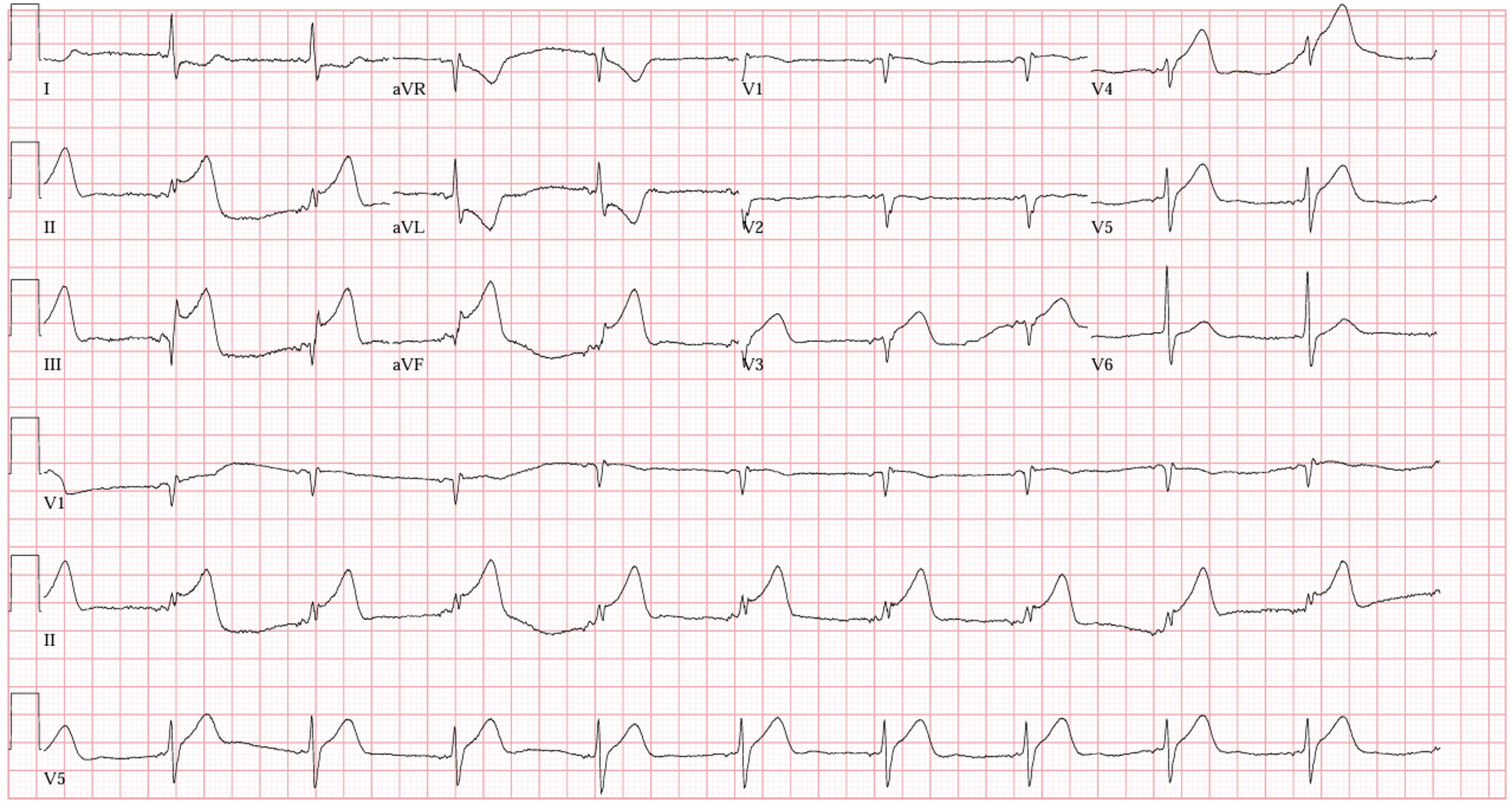
Rate: 60
Rhythm: Sinus Bradycardia
Axis: Normal
Intervals: Narrow QRS complexes (don’t get tricked by the gigantic ST segment elevation) and normal PR interval.
Morphology: MASSIVE ST segment elevation in II, III, and aVF. You have reciprocal changes in I and aVL.
Final read: This is a massive inferior MI.
“Shannon, this is a massive inferior MI. Funny how that came across right as you were telling me the cath lab is down…”
“I’m not laughing doc…” she says.
“This is Medic 2915 requesting emergency medical command.”
“Medic 2915, this is the hospital, please be advised we are on STEMI redirect, our cath lab is down.”
“Understood doc, going to need to request emergency override. We have an unstable STEMI and you are the closest facility. 68-year-old male. We got the call for chest pain and found him minimally responsive with agonal respirations. Initial blood pressure 72/40. Satting in the 60s on room air. We intubated him, hung fluids and sent you that ECG. We cannot make it to the next nearest facility with a working cath lab… that’s over an hour drive. Will need to come to you.”
“Medic 2915, are you able to rendezvous with med evac and fly the patient to a cath lab?”
“Negative, Doc. Air is black at the moment. The bird is tied up until 1600, they’re mid transport with a sick kiddo going to the PICU.”
You and Shannon look at each other. “Guess I’ll go prep the last remaining resus room for this patient” she says as she heads off.
“OK Medic 2915, diversion override is approved. How far out are you?”
“Hang on Doc. We have a rhythm change again. Sending you the ECG now. Hold on one sec. Hey! Bill! Do you have a pulse on him still?”
“Doc, this ECG just came through from EMS,” your tech tells you as you’re waiting by the phone for updates:
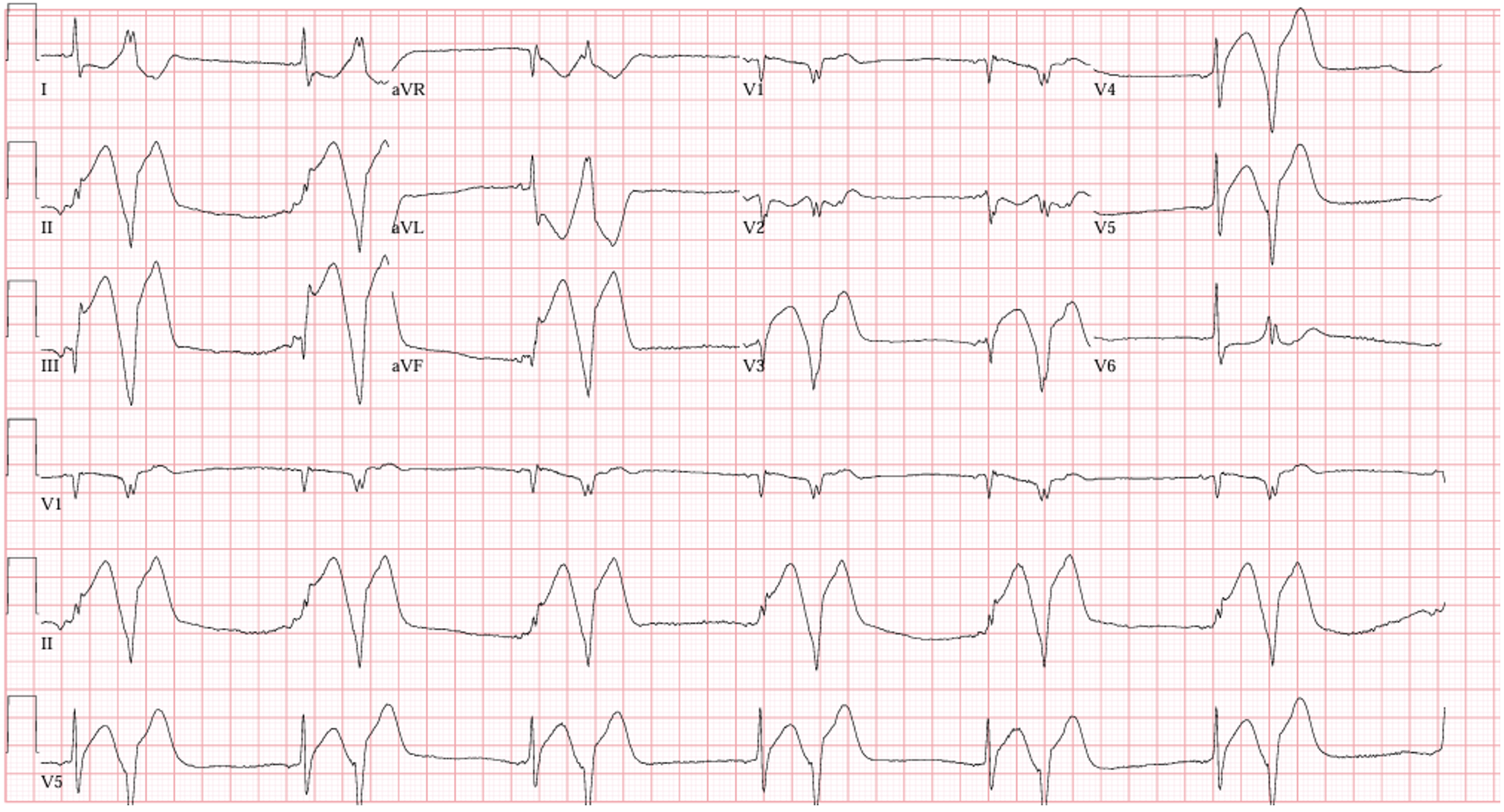
Rate: This is a tough one. The rate is actually 72 but the machine will probably say 36.
Rhythm: I think we still have P waves, so we have a sinus beat and then a not sinus beat.
Axis: Normal
Intervals: first beat shows a normal QRS duration and then a weird “M”-ish type complex.
Morphology: Still HUGE ST segment elevations present. But then an “M” shaped beat?
Final read: Massive Inferior MI with a morphology change. This second “M” shaped beat is a PVC that just looks very strange due to the significant amount of ST segment elevation. This patient is in bigeminy.
“Medic 2915 are you still there? Hello!”
“Hey Doc, sorry, this guy is super sick. We still have a pulse on him. What’s up with that ECG? I didn’t realize hearts could spell letters on an ECG. We’re two minutes out. See you soon.”
“Sounds good Medic 2915, we’ll see you soon.”
You run back to the resus bay and find the team ready to go. Medic 2915 comes rushing in, looking stressed.
“Doc! Increased ectopy and BP falling. This is not looking good right now. Transferring him over to your bed on 3 .. 2.. 1… Good luck. We’ll stay in the back and watch.”
“Let’s get him hooked up to the monitor and get defibrillation pads on him ASAP, please.” You say.
“Going on the monitor now. Oh. That’s not good” you hear Shannon say.

“Shit, he’s in VFib. Start compressions! Charge the Zoll and get ready to defibrillate” you call out.
“Zoll is charged, Doc. Ready when you are!”
“Clear off the patient. Shock now!”
“Shock delivered. Still looks like Vfib.”
“Resume CPR! Scott, where are you?” you call to the pharmacist.
“Right here. Here’s your first epi. What else do you want? Besides a working cath lab…”
“Funny. Prep the lytics. Asap.”
“Second shock delivered, we have ROSC!” you hear the senior resident call out as you were talking to Scott.
“What were you guys saying about lytics?” the senior asks. “We’re usually a cath lab center, so I don’t think I’ve ever given lytics before. Now that we have ROSC, let’s start some pressors and try to get this guy as stable as we can for transfer. Scott, tell me more about lytics quickly?”
I’m so glad you asked! Now, remember, if you cannot get the patient to a PCI center within 120 minutes, you should give lytics, ideally within 30 minutes of arrival to the hospital. In the spirit of ensuring safe and effective medication use, let me run through the contraindications to fibrinolytic therapy as outlined in the Acute Coronary Syndrome guidelines:
- Any prior intracranial hemorrhage
- Known structural cerebral vascular lesion
- Known malignant intracranial neoplasm
- Ischemic stroke within 3 months except acute ischemic stroke
- Suspected aortic dissection
- Active bleeding or bleeding diathesis (excluding menses)
- Significant closed-head or facial trauma within 3 months
- Intracranial/Intraspinal surgery within the last two months
- Blood pressure >180/110mmHg
There are a handful of other relative contraindications including traumatic or prolonged (10minues) CPR but I will spare the whole list since time is also on a shortage (much like every other drug we love). Luckily, we got this guy back with less than 10 minutes of CPR, or we’d be having a very different risks/benefits conversation.
As we’re talking, I’m mixing up Tenecteplase (TNK) as a weight-based bolus. The notable difference between this and its predecessor Alteplase is the increased fibrin specificity, which is associated with lower noncerebral bleeding occurrence in a comparator trial and significantly more straightforward dosing calculation and preparation.” (Note: That’s the ASSENT-2 Trial that Scott is referencing here)
“Ok, great talk Scott. Now can we please get the lytics into this guy and get him packed to get out of here?” you ask.
“Here you go! Lytics all mixed and ready to be given. Any other questions about lytics? I know we don’t give them here very often for STEMI.” Scott asks, turning to the residents.
Case Wrap Up
“Hello! Med Evac command? This is the hospital requesting a stat transfer for an unstable STEMI. 68-year-old male, inferior MI, briefly arrested but ROSC after 2 shocks. We have him on 2 different pressors and have given lytics as our cath lab is down. How soon can you get him out of here? I have an accepting team ready to do PCI about a 30-minute flight from here.”
“Doc, we are still mid transport to PICU. We cannot support your request at this time but will activate emergency procedures to try and get another helicopter team spun up as soon as possible. Best of luck to you and the team.”
“Understood, transfer center, get me EMS command please, we need to figure out how to get this patient out of here…”
Recap:
- ECGs from patients having a STEMI can do some WILD things! I’d never seen one look like an “M” before.
- Cath lab down time is a big problem and can cause unexpected barriers to patient care. Make sure to involve your leadership, as there is usually a backup plan in place.
- Unfortunately, sometimes you just have to make do with what you have.
- A good ED Pharmacist is worth his/her weight in gold.
- Always run through contraindications for medications that you don’t give very often.