
Neurogenic Shock: Definition, Identification, and Management in the ED
Kira Brayan and Jenny Beck-Esmay cover neurogenic shock!
Neurogenic Shock: Definition, Identification, and Management in the ED Read More »

Kira Brayan and Jenny Beck-Esmay cover neurogenic shock!
Neurogenic Shock: Definition, Identification, and Management in the ED Read More »

What do you need to know about maxillofacial trauma?
Maxillofacial Trauma Read More »
This week 52 in 52 covers the P-CAT trial and pigtail catheters for hemothorax.
52 in 52 – #6: The P-CAT Trial Read More »
A 60-year-old female presents to the ED with an impaled object in her arm. She stabbed herself in the left arm as an act of self-harm, prior to calling EMS. The object was wrapped in gauze by EMS. On ED evaluation, she is stable and alert and oriented. On your primary and secondary evaluation, there is only one injury. Under extensive gauze wrapping, there is a large, serrated knife impaled in the distal aspect of the left flexor forearm. It is superficial and can be easily palpated along the skin. There are no other injuries identified on primary and secondary surveys. She is neurovascularly intact. What is the next step in your evaluation and management?
EM@3AM: Impaled Objects Read More »
The ’52 in 52′ series is back with emergency resuscitative thoracotomy.
52 in 52 – #4: Emergency Resuscitative Thoracotomy Read More »
A 30-year-old male presents to the ED via EMS with severe hip and groin pain after an accident. He denies loss of consciousness, is not on any blood thinners, and currently complains of pain in his hips/groin. Initial assessment on arrival includes vital signs BP 134/86, HR 94, RR 16, SpO2 98% on room air, and temperature 99.0F. He is speaking and mentating appropriately but in significant discomfort when you exam his pelvis. Blood is seen at the urethral meatus, and the pelvis is unstable. There is no obvious perineal ecchymosis at this time. The rest of the exam is unremarkable. What type of injury should be considered with blood at the urethral meatus and suspected pelvic fracture?
EM@3AM: Bladder Rupture Read More »

How should you evaluate and manage the patient with spinal cord injury?
We Have Your Back: ED Presentations, Evaluation, and Management of Spinal Cord Injuries Read More »

What can go wrong with IV fluids? This post from Adam Lalley looks at potential harms.
Rubbing Salt into a Wound: Potential Harms of IV fluids Read More »
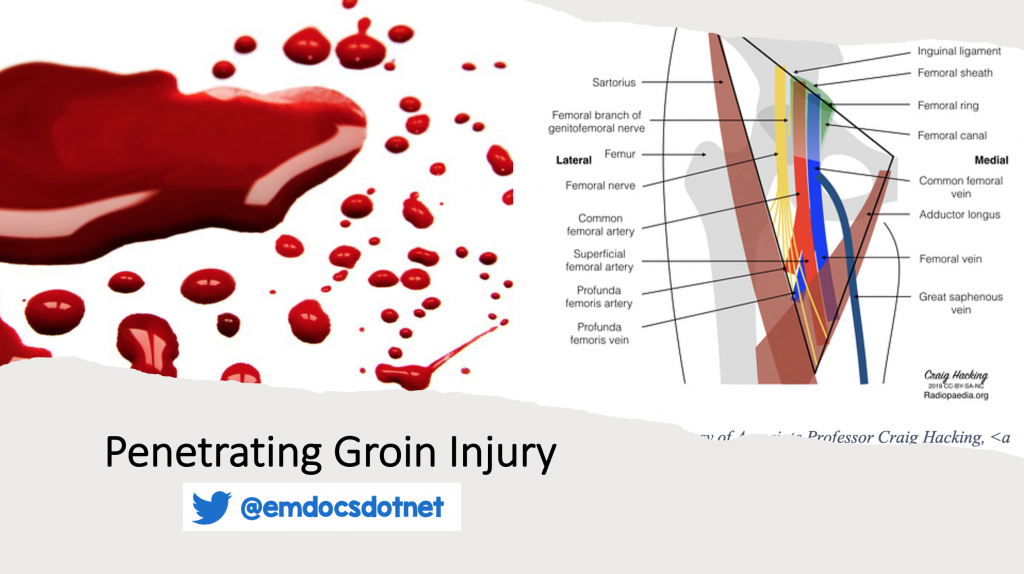
How do you care for the patient with a penetrating wound to the groin? What should you consider?
Penetrating Wound to the Groin Read More »

This practice is also commonly applied to patients with non-traumatic causes of obtundation. However, the evidence behind this practice is not clear, prompting many to re-examine this oft-repeated lesson.
R.E.B.E.L. EM – Dogmalysis: GCS <8, Then Intubate? Read More »